
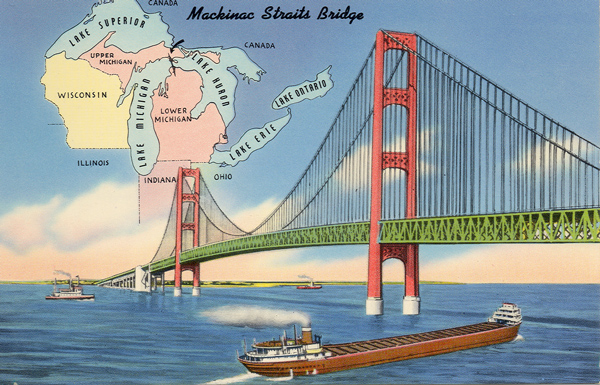
Rising 552 feet (that's 55 stories!) above the Straits of Mackinac (pronounced MA·kuh·naa), where lakes Michigan and Huron meet, is the world-famous Mackinac Bridge. Also known as the "Mighty Mac," this engineering marvel is 5 miles long. It is the world's 27th-longest main span and is the longest suspension bridge between anchorages in the Western Hemisphere.

The need for a bridge
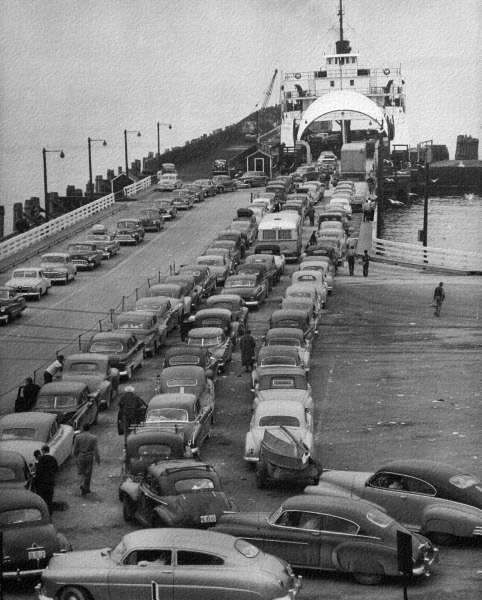
Before the Mackinac Bridge was constructed, travelers between Michigan's upper and lower peninsulas had to cross the Straits via an hour-long ferry ride. On busy weekends, like the start of hunting season or the Fourth of July holiday, carloads of anxious travelers would wait in line up to 24 hours to catch a ferry.
Although the bridge was envisioned way back in the late 1800s, Senator Prentiss M. Brown, Sr., the "Father of the Mackinac Bridge," was the key figure in the bridge construction project. Governor-elect G. Mennen (Soapie) Williams was another strong advocate for the bridge and helped to create the Mackinac Bridge Authority in 1950. The bridge designer was Dr. David B. Steinman and the primary construction firms were Merrit-Chapman & Scott and the American Bridge Division of U.S. Steel.
Today, the Mackinac Bridge is hailed as one of the most outstanding engineering achievements of the century and leaves people wondering how Michigan ever got along without it! The 100 millionth crossing of the bridge happened on June 25, 1998.
The construction period: 1954-57
Because the bridge was in a remote area, financing the project was slow and difficult. The total cost of the project was upwards of $100 million (originally estimated at $70 million).
Construction began in 1954 and during the 42 months that followed thousands of people worked on the various phases of the bridge construction.
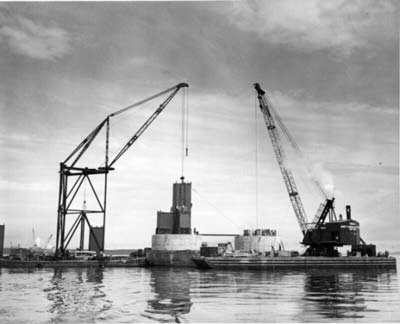
The first step was to sink the large, double-walled cylinders that formed the bases of the two main tower piers. These cylinders are called caissons (cay-säns). The caissons had to be sunk into the bedrock on the lake floor, a great challenge for the divers involved.
When the foundation pillars were finished, the iron workers began to string the massive cabling network! Over 500 workers were housed in St. Ignace, Michigan, during this construction period.
A "catwalk" made of cyclone fence enabled the workers to navigate between the bridge towers, high above the lake below.
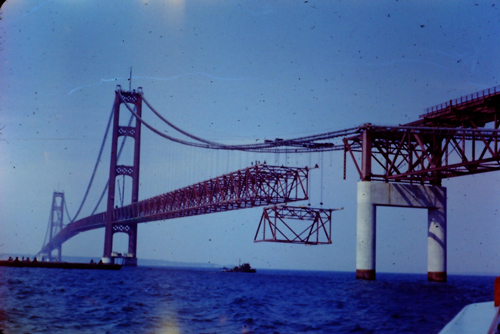
When finished, the cables were close to 25 inches in diameter. Each cable consists of 340 wires banded into a single strand; 37 strands are then assembled into a single cable. To complete the job and add extra strength, a covering is spun around each finished cable. More than 42,000 miles of wire were used in the two main bridge cables!
The last step was to construct the road surface. The inner lane on the middle span of the bridge includes an open grid riding surface. This was installed to allow wind forces to move through the bridge.
Watch this documentary “Building the Mackinac” about the historic construction of the Mackinac Bridge. It was written, narrated, and produced by Mark Howell in 1996.
Bridge trivia
How much steel wire was used? The total length of steel wire spun together to form the two main cables is 42,000 miles -- enough to circle the globe one and one-half times!
Did anyone die during the construction? Five men lost their lives during the bridge construction: one fell from a tower, one diver surfaced too quickly and did not recover, and three ironworkers fell from a catwalk collapse. There are memorials for these men near the bridge.
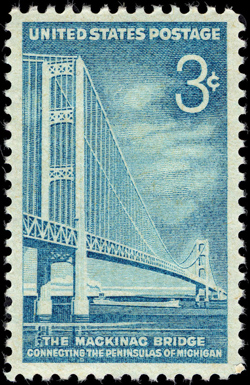
When was the bridge opened to the public? Opening day for the Mackinac Bridge was Nov. 1, 1957, although the official grand opening celebration was postponed until June 26-28, 1958, because the organizers anticipated poor weather in late November. Ironically, the June celebration was marred by fog and rain anyway. To mark the dedication of the bridge, the USPS issued a three-cent U.S. postage stamp, on June 25, 1958.
Do you have to pay to cross the bridge? To offset operating costs, fares are collected for crossing the Mackinac Bridge. The current fare is based on the size of the vehicle and the number of axles it has.
What's a Timmy? Some people to this day are afraid to drive across the Mackinac Bridge, typically because of a fear of heights. Their timidness has earned them the nickname "timmies" by the fare collectors and Bridge Authority. In extreme circumstances, "timmies" will be chauffeured across the bridge by bridge personnel or the local authorities.
Isn't the Golden Gate longer than the Mighty Mac? Although the center span of the Golden Gate Bridge in San Francisco, California, is longer than the Mackinac Bridge, from foundation pier to foundation pier, it is 2,164 feet shorter than the "Mighty Mac." The total length of the suspended section of the Mackinac Bridge is 8,614 feet; the same suspended section of the Golden Gate Bridge measures 6,450 feet.
How long will the bridge last? It is already over 65 years old. The Mackinac Bridge has withstood some incredible winds and severe snow and rain storms and has shown little sign of weakness. The original bridge architects and designers say that, if properly maintained, the bridge will probably last for 1,000 years! The bridge takes a lot of maintenance, including snowplowing, filling potholes, painting, and resurfacing.
Find out more about the history of building the bridge by visiting the Mackinac Bridge Authority website.
Walk across the Mackinac Bridge! It is a Labor Day tradition for some people. Your family can join them!
Visit your local library and check out a book about the Mackinac Bridge. There are several, including the “Mackinac Bridge” by Mike Fornes and “Mighty Mac: The Official Picture History of the Mackinac Bridge” by Lawrence A. Rubin