
Gene Stratton-Porter (1863-1924)

As a child, Gene Stratton-Porter's solitary habits were focused on nature study. She loved to observe birds and all manner of living things. This passion and a desire to support herself led to a career writing articles, which she illustrated with her own photographs. Her fiction, an immediate hit with national magazines, evolved into popular novels and poetry. Many of the books were based on nature themes and strong characters, such as in The Girl of the Limberlost. She became Indiana's most popular writer with a claimed 50 million readers, and eight of her books were made into movies. Her influence caused Americans to rethink the country's headlong rush into resource depletion and led the way for national conservation initiatives. In 1912, she purchased land on Sylvan Lake in northeast Indiana to build a second log home. This place, "Wildflower Woods," became an outdoor laboratory where she created research gardens and a wildlife refuge.
Aldo Leopold (1887-1948)
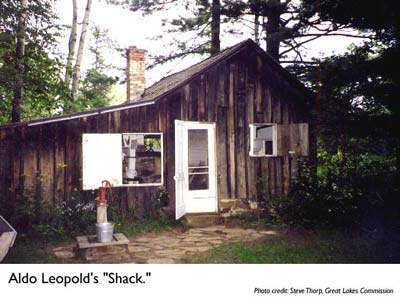
Aldo Leopold grew up in a handsome home overlooking the Mississippi River and was always in touch with his
natural surroundings. Whether playing on the bluffs, hunting with his father or inventorying a wooded domain as a young forester from Yale, Leopold took serious note of landscapes and their natural features. As a professor of game management at the University of Wisconsin, he pioneered many basic principles of ecosystem management, specializing in predator-prey relationships. It was a volatile field, requiring careful balance among the politics of hunting, goals of wilderness protection and wise use of natural resources. Leopold relaxed at a rural acreage about an hour's drive north of Madison. Here the activities of family life included efforts to restore vegetative health to the former farm. "The Shack," once a chicken coop, provided shelter, but the entire property was a contemplative retreat for Leopold. His famous book, A Sand County Almanac, crystalized here.
Sigurd Olson (1899-1982)
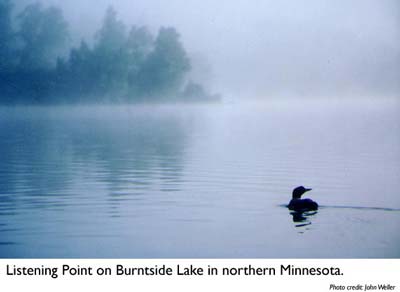
Sigurd Olson, a self-described conservationist, is remembered as an environmental philosopher. His principal subject matter was wilderness and, for many, his ardent support of wilderness preservation bordered on religion. Olson believed wilderness enabled people to feel the timeless, creative force of the universe. His own serene experiences canoeing on the Minnesota-Ontario border were incomparable treasures. A longtime resident of Ely, Minn., he fought developers and logging interests who sought to exploit the nearby Superior National Forest. His success resulted in lasting protection of the 1,000,000-acre Boundary Waters Canoe Area and designation of Voyageurs National Park. Through his writings, including The Singing Wilderness, as well as his environmental activism, he developed a national reputation. He became president of the National Parks Association and lobbied for the Wilderness Act, signed in 1964. He maintained a cabin on nearby Burntside Lake, a place that inspired the book, Listening Point.
Rachel Carson (1907-1964)
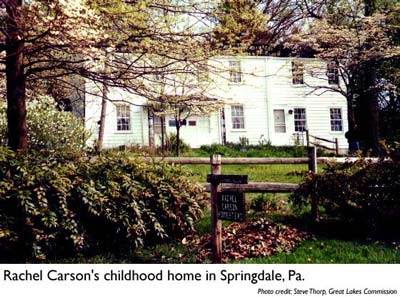
The modern environmental movement was boosted, if not launched, by the publication of the 1962 best-seller, Silent Spring. The book's author was Rachel Carson from Springdale, Pa. In 1900, her family bought some hillside property on the Allegheny River a few miles outside of Pittsburgh. The five-room clapboard house had no central heating or indoor plumbing. It was here that the young Carson, guided by a mother inte rested in nature study, began to construct her world view. She spent a great deal of time outside, deciding to learn as much about the environment as possible. Her studies took her to Johns Hopkins University for graduate work in marine biology. She worked for the federal government as a natural history writer while she cared for her parents and siblings, leaving little time for a personal life. Several books, including The Sea Around Us, brought her fame, but her biggest literary accomplishment was Silent Spring. This book, linking indiscriminate pesticide use with bird population declines, took on the chemical industry. Her tremendous courage in the face of an orchestrated disinformation campaign and personal attacks by her detractors, while suffering from cancer, is her legacy to us all.