What's in a name?
It is people who give a place its name. Naming rivers, lakes, trails, mountains, and valleys gives them extra meaning. It also makes it easier for people to give directions and have conversations about places! Places can be named after the plants and animals that live there, the landscape, people, or events that occurred there. Names give us a relationship to a place and help us remember it. Think of towns, rivers, and lakes near where you live. Do you know how these places were named? .
The first inhabitants of the Great Lakes region were American Indians who gave each lake a unique name. French explorers adopted some of these names and changed others. Native peoples continue to use their original names. However, the names used on maps are the result of translations and changes over the years.
Lake Erie
Most of Lake Erie’s southern shore was at one time occupied by a tribe of Indians known as the Eries. The Eries' name for themselves was Erielhonan, or "Long Tail." Early French writers thought this name referred to a wild cat or panther, and so they called Lake Erie, “Lac du Chat” meaning "Lake of the Cat." Later, the French referred to it as Lac Erie.
The Erie tribe was nearly completely destroyed during the Beaver Wars of the mid 17th century. Remaining people were absorbed by various tribes in the region.
More on Lake Erie
Lake Huron
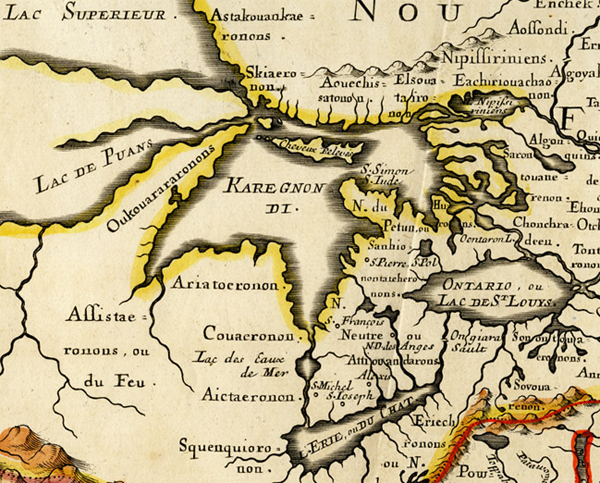
Nicolas Sanson’s map in 1656 called this lake, Karegnondi. This name is probably some version of the name the native inhabitants used. When the French explorers arrived, the first of the Great Lakes they encountered was Lake Huron. They named it La Mer Douce, the sweet or fresh-water sea.
On later French maps, Lake Huron was labeled "Lac des Hurons" or Lake of the Hurons. Huron is a name that the French gave this tribe. They call themselves “Wendat” meaning “island people.”
More on Lake Huron
Lake Michigan
The Ojibwe name for Lake Michigan is "Michigami" meaning “really large body of water.”
Champlain called it the Grand Lac. It was later named "Lake of the Stinking Water." Another story recounts that Nicolet, the first European to set foot in Wisconsin in 1634, landed on the shores of Green Bay and was greeted by the Winnebago, whom the French called "Puans." And so, Lake Michigan was labeled "Lake of Puants" on an early and incomplete 1670 map of the region.
On maps from 1679 and 1688, the lake is named Lac des Illinois because it gave access to the country of the Illinois tribe to the south. Others called it Lac St. Joseph and Lac Dauphin until the lake received its current name, Lake Michigan.
More on Lake Michigan
Lake Ontario
The Huron word for the lake, “Ontari:io,” means “great water,” similar to the Ojibwe perspective on other sections of the connected water.
Champlain called it Lake St. Louis in 1632. On Nicolas Sanson’s 1656 map, it remained Lac de St. Louis. A Jesuit historian named Francis Creuxius is credited with settling on Lacus Ontarius, or "beautiful lake."
More on Lake Ontario
Lake Superior
The Ojibwe name for Lake Superior is "Gichigami,” which means “large body of water.”
In the 17th century, Jesuit missionaries named it Lac Tracy after Alexandre de Prouville de Tracy. That name didn’t last long.
The first French explorers approaching the great inland sea by way of the Ottawa River and Lake Huron referred to their discovery as “le Lac Superieur”. Properly translated, the expression means "Upper Lake," that is, the lake above Lake Huron. When the British took control of the region, the name became Lake Superior.
More on Lake Superior
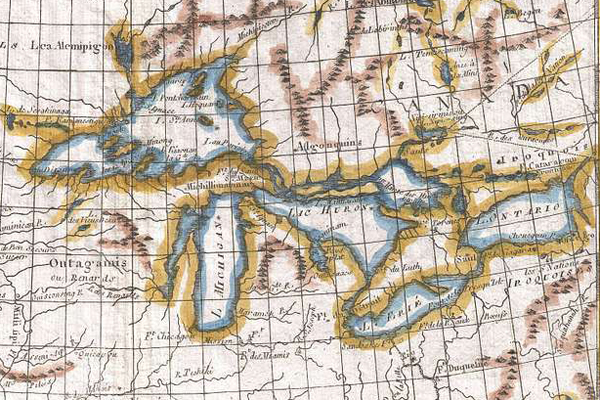
To further explore the mapping of the Great Lakes region, visit the University of Wisconsin-Sea Grant website. Their online Great Lakes Maps exhibit titled "Making Maps Mapping History" is fascinating. The mobile version seems to work better than the full version.