
Native Peoples found all the things they needed to survive in the water and on the land where they lived. Native Peoples continue to pass down this knowledge and practice these same skills.
Fishing
Fish is a primary source of food for the Native Peoples of the Great Lakes region. The Ojibwe established villages at Sault Sainte Marie, Michigan and other places on the Great Lakes partially because of their fish populations. Native Peoples also discovered the bountiful fishing banks along the south shore of Lake Erie and the archipelago to Point Pelee. They regularly crossed Ohio from the Ohio River to Lake Erie over paddle-and-portage routes (up the Miami River and down the Maumee River) to these fishing grounds. Sturgeon, lake trout, and whitefish are popular catches.
Tribal fishermen continue to harvest fish using large birch bark canoes and seine nets (later gill nets) constructed from twisted and knotted strands of willow bark. They also spear through the ice and fish with hand carved decoys. As Europeans pushed into the Great Lakes region, the Native Peoples used fish to trade with French and English outposts. Fish soon became one of the mainstays in the diets of the early fur traders.
Native Peoples dried fish over racks to preserve them for a short time. In late fall, they hung the fish from racks of poles and allowed them to freeze quickly. Lake Superior tribes stored frozen fish and berries in cache pits near water.
Hunting
By Ojibwe tradition, it was time to hunt deer (waawaashikeshii) when they began to see fireflies making small sparks in the night air. In addition to deer and elk, the Native Peoples hunted bear and smaller fur-bearing animals such as rabbits, beaver, and fox.
Follow along as Greg “Biskakone” Johnson (a member of the Lynx Clan and an enrolled member of the Lac du Flambeau Band of Lake Superior Chippewa) hunts a deer. Learn how his passion for keeping traditional ways alive includes hunting deer and using nearly all parts of the deer for food, clothing, and tools.
Gathering
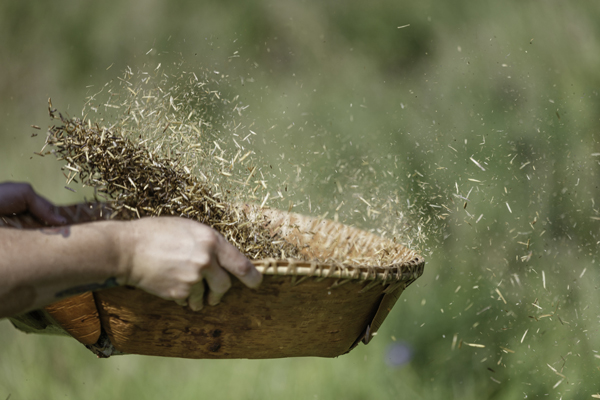
The traditional harvesting of wild rice (“manomin” in Ojibwe) is integral to the diet and livelihood of Ojibwe people and other Great Lakes tribes in northern Minnesota, Michigan, and Wisconsin. The Rice Making Moon in August signals the beginning of the harvest season. This is a time to celebrate surviving the year. Sensitive to weather conditions and water levels, the abundance of wild rice can vary greatly from year to year.
Manoomin had great importance to early European explorers as well. Their journals contain many references to the plant they found growing on the lakes and riverways they traversed. As a staple food of the Voyageurs, it helped the regional fur trade flourish.
Tribal members also know where to find the wild fruits and berries, roots, seeds, and nuts that sustain them. But finding them is not enough! They must knew which part to harvest, when to harvest, how to prepare, and how to store. This knowledge continues to be passed down from generation to generation, along with knowledge of medicinal plants.
The gathering and boiling of maple sap is also an annual task and celebration.
Farming
Native Peoples are excellent farmers. Common crops grown in the Great Lakes region included corn, squash, pumpkins, beans, and Jerusalem artichokes.
The importance of birch bark canoes
Canoes allowed the Native Peoples to navigate long distances on the region's lakes and rivers while fishing, hunting, and gathering. The Native Peoples around the Great Lakes perfected the fine art of building a canoe from materials gathered in the forest. They could paddle distances of 300 miles in 15-16 days.
Of course, the canoe was always at the mercy of violent weather on the Great Lakes. Tragedies could occur if canoes ventured too far from land and a sudden storm arose. At one time the Ho-Chunk, on the western side of what is now Lake Michigan, were at war with the Foxes on the eastern side of the lake. The Ho-Chunk sent an army of 500 individuals, but they all perished while making the Lake Michigan crossing. It is said that the Fox were so moved by the disaster that they ceased making war on those who remained.