The International Joint Commission (IJC), created as a result of the Boundary Waters Treaty of 1909, conducted studies on the water quality of the Great Lakes in the 1960s, determining that excessive phosphorus was causing eutrophication in the Great Lakes, particularly in lakes Ontario and Erie.
In response to the IJC study, the United States and Canada signed the Great Lakes Water Quality Agreement (GLWQA) in 1972. GLWQA established pollution control levels (mainly to reduce phosphorus levels in lakes Ontario and Erie), binational water quality research and monitoring efforts.
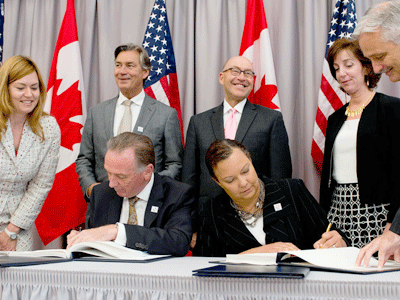
In 1978, the Agreement was renewed to reduce the phosphorus levels for all of the Great Lakes and called for the elimination of all POPs discharging into the lakes. This amended agreement focused on the Great Lakes as a connected system and established an objective to restore and maintain "the chemical, physical and biological integrity of the Great Lakes basin ecosystem."
The United States and Canada most recently renewed the GLWQA in 1987, this time focusing on NPS pollution, contaminated sediments and airborne pollutants. New management approaches also were established, including Remedial Action Plans (RAPs) and Lakewide Management Plans (LaMPs). RAPs focus on the 43 (now 42) geographic Areas of Concern, and LaMPs are designed to improve the environmental quality of the open waters of each of the Great Lakes, with a particular focus on critical pollutants.
The IJC publishes biennial reports on how well the United States and Canada are following the regulations and goals established in the GLWQA. The most recent report in 2000, while acknowledging that the two countries have done much to control point source pollution of toxic chemicals, criticized both countries for their failure to control the rise of contaminated sediments and airborne pollutants, which are both caused by toxic chemicals and lead to many wildlife and human health problems.
Other legislation and government organizations impacting the water quality of the Great Lakes include the following:
United States
- Clean Water Act of 1972 and 1977
- National Environmental Protection Act (1969)
- Great Lakes Toxic Substances Control Agreement (1986)
- U.S. Environmental Protection Agency (EPA)
- EPA-Great Lakes National Program Office (GLNPO)
- State EPA or environment management offices: WI | IL | IN | MI | MN | NY | OH | PA
- Great Lakes Commission
- Great Lakes Environmental Research Laboratory
- Great Lakes Fishery Commission
Canada
- Canada Water Act
- Canadian Environmental Protection Act of 1988
- Environment Canada
- Ontario Ministry of the Environment
Grassroots, community and individual involvement
While legislation and laws ultimately determine the regulation of pollution entering the lakes, advocacy efforts are what often prompt governments to enact and enforce these laws. Major Great Lakes advocacy groups are listed below.
Individuals can also do their part in reducing water pollution. Examples include the following: stop using lawn pesticides and fertilizers; dispose of oil and paint in a recycle center; control soil erosion by replacing sections of your lawn (or your entire lawn!) with native plants; and keep litter and leaves out of your street gutters and storm drains.
- Lake Michigan Federation
- National Wildlife Federation Great Lakes Field Office
- Sierra Club Ontario Chapter
- Sierra Club state chapters