
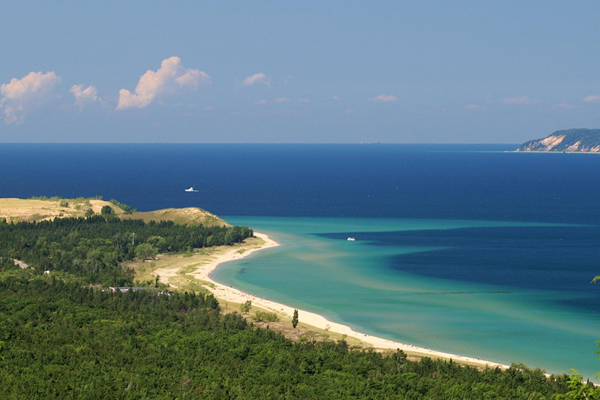
The Great Lakes are bountiful sources of food for Native Peoples and, therefore, well respected and often the subject of spiritual practices. Here you can read a few of the many oral traditions of Wisconsin’s First Nations. The traditions of each culture are rich and diverse. To learn from more, ask your grownup to visit some of the resources under the “For adults” tab.
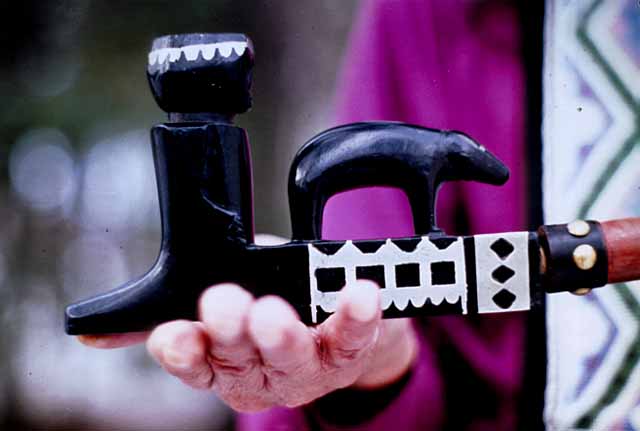
Native Peoples, especially among the Ottawa and Ojibwe of Michigan and Wisconsin, regard the black bear with reverence as their relative. Although some tribes do not hesitate to kill the bear when in need of food, they seek to appease the bear’s spirit with elaborate apologies. A bear hunt is a great event, as are all hunts, to be undertaken with much preparatory ceremony.

This story is told around the twin ports of Fort William and Port Arthur in the Thunder Bay region of Ontario. This accounts for the great rock mesa on the edge of the harbor.
Long ago, in the days when the gods roamed the earth, Nanabooshoo lived with his spouse on distant shores of the lake. Evil days came upon the world; the mighty hunter could find no game in the woods, and the fish did not enter his nets. His squaw, tormented with the agonizing pains of hunger, chided and scorned him, until, enraged beyond control, he smote her with his great war club and she fell lifeless at his feet. Horror-stricken, he fled the wigwam and into the night. The wailing wind shrieked accusations in his ears; the spirits of the rocks and trees rebuked him. Before his horrified eyes rose the specter of his murdered wife, haunting him as he sped onward. Finally, half-crazed with terror and remorse, he staggered and fell backward into the waters of the lake. The Great Spirit took pity upon the giant and conferred the boon of rest by turning him to everlasting stone.
“The Sleeping Giant," from Lake Superior, The American Lake Series, by Grace Lee Nute
The Attawandaronk, parents of the Huron-Iroquois, displayed in one of their villages near the Niagara River a crude statue of a woman called Ji-gon-sa-seh (the Mother of Nations). According to Onondaga tradition, she is considered the lineal descendant of earth's first woman and was created together with the first man in a "garden of Eden" located on one of the two branches of Sandy Creek, which merge to flow northward to Lake Ontario.
Another story concerns a pregnant woman who fell from heaven to the back of a giant turtle, which expanded swiftly into the continent of North America. The woman bore twin sons, the Dark One and the Good One. Quickly maturing, they wrestled for mastery. Their struggle shook the earth and caused a mighty storm with winds that scooped the earth into valleys and raised rocks and soil to form hills. The Good One finally threw the Dark One down with such force that he crashed through the floor of the world and fell into the fiery lake that is the molten core of the Earth. From his endless torment the Dark One eternally sends up troubles for the Good One and tribulations to his children.
"Stories from Iroquois Oral Tradition" from Lake Ontario, American Lake Series, by Arthur Pound

According to the teachings of the Chippewa (also known as the Anishinabe people), it was the sacred Megis Shell that first guided the people to the rich regions of the Great Lakes, most notably to the prized waters of Gitchi Gummi (big water) or Lake Superior. The Megis Shell was last seen near Madeline Island, which was a settling point for the tribal people migrating from the eastern shores of the continent. Today, the abundance of the Great Lakes to which the Megis led the Anishinabe people has been somewhat diminished, but the people have not, and their love for Gitchi Gummi has not. The people have endured, and as one with the land and the water, will endure long into the future.
Legend courtesy of Great Lakes Indian Fish & Wildlife Commission
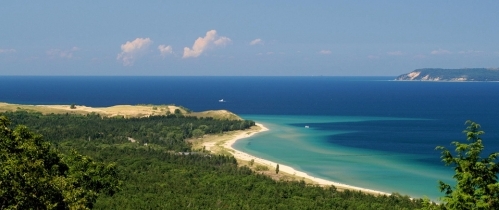
This story relates that there was once a terrible forest fire on the Wisconsin side of Lake Michigan, which drove all the animals into the water. Among them were a mother bear and her two cubs who, to escape the flames, struck out for the Michigan shore. They swam for several days, but the cubs became confused in the smoke and before reaching the land their strength gave out. The mother bear, on landing, paced the shore for days, calling in vain for her children, until at length she too became exhausted and fell asleep. Sand swept over her and there she still lies, looking out upon the lake. To reward her devotion, the Great Spirit created North and South Manitou Islands where the cubs sank from sight. Here they remain to this day.
From Lake Michigan, American Lake Series by Milo M. Quaife
Native Peoples, especially in the Lake Superior region, are known to say a prayer, accompanied with a gift of tobacco, whenever they pass a remarkable or dangerous place on the Great Lakes or when they first go out venturing into the water.
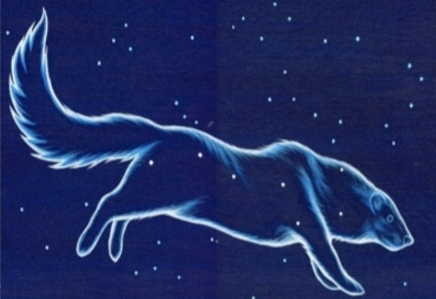
To understand this story, one must know that the fisher is an animal in the marten family, a relative of the mink, that was formerly a common inhabitant around the lake. In the Ojibwe language, the Great (Big) Dipper constellation is the Great Fisher star.
The story goes that as Nanabooshoo was out walking one day, he heard a pleasing song. Hastening to the spot whence it came, he reached the shore of Lake Superior and saw a Great Fisher holding the shores together by leaping back and forth from shore to shore while he sang:
The shores of the sea meet together,
The shores of the sea meet together.
Nanabooshoo watched and listened in rapt admiration for a time and then exclaimed, "Could I do that, too?" So the Great Fisher allowed him to take his place, warning that Nanabooshoo must do exactly what he had just seen and heard and that never by any chance must he sing:
The shores of the sea draw apart,
The shores of the sea draw apart.
The Great Fisher went off and Nanabooshoo leaped back and forth singing:
The shores of the sea meet together,
The shores of the sea meet together.
The shores were held together and all went well until a day or two had passed. Then Nanabooshoo began to grow weary and wonder what would happen if he sang the other song. So he began to sing:
The shores of the sea draw apart,
The shores of the sea draw apart.
He immediately fell into the lake and when he came to the surface, not a piece of shoreline could he see! He began to struggle and to call on the Great Fisher for help. The Great Fisher heard him and returned, singing the original song and leaping back and forth. The shores drew together once more and Nanabooshoo was saved.
"Outlet of Lake Superior," from Lake Superior, The American Lake Series by Grace Lee Nute
The ongoing health and well-being of the Earth as she moves through the changing circle of her seasons each year is of major importance to the Ojibwe people. Traditional recognition of the interconnectedness of all living things contributes to a holistic view. "It is with thanks that life is taken so we might live," the Ojibwe say, "but we must also seriously consider the well-being and preservation of all species and look forward to the needs of the Seventh Generation."
As those that walked before us provided for the well-being of today's people, so must we think of who will walk the Circle in many years to come.
The Earth's water system is compared to the human circulatory system in Ojibwe thought. "Water, as it flows through the rivers, lakes and streams, seeps through underground passageways or spurts out of the Earth's surface as an artesian well," they say.
Water, known as "nibi" in Ojibwe, is the source of life and, as such, becomes the responsibility of women. Nibi must be protected, kept pure, for all life now and to come.
"Preserving the Circle of the Seasons" from the Great Lakes Indian Fish & Wildlife Commission.
Share some Ojibwe stories with your child. Here is one about Manabozho and the Maple Trees.
Enjoy stories on language and culture from native communities around the central Great Lakes
Listen to a Ho-Chunk elder share a bit of his tribal history.
Read the story "Why the Chipmunk has black stripes."