
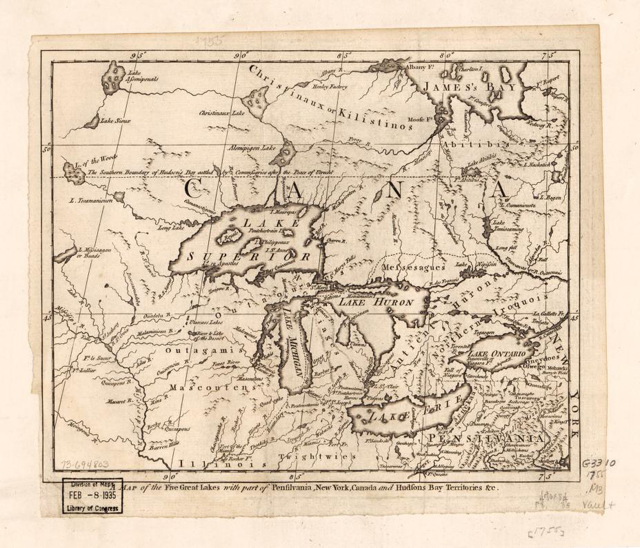
The Great Lakes are rich in natural resources. They provide abundant fresh water, food such as fish and wild rice, and a network of lakes and rivers for travel and trade. Many tribes competed for access to these resources.
Lakes Superior, Huron, and Michigan
Seventeen tribes were well-established on the lands surrounding lakes Superior and Huron. Among these were the Ojibwe, Cree, Monsoni, Ottawa, Huron, Assiniboin, Menominee, Winnebago, Potawatomi and Nipissing. Further north and west in present-day Minnesota was the Sioux tribe. Prominent tribes around Lake Michigan also included the Fox and Miami.
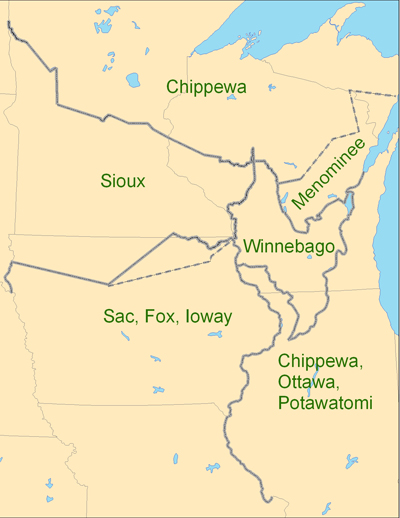
The Treaty of Prairie du Chien (the Fond du Lac agreement) made peace between the Sioux and the Ojibwe (noted as Chippewa on map) and arranged for a boundary line between them to be run through parts of what we now know as Wisconsin and Minnesota. One significant clause read this way: "The Chippewa tribe grants to the government of the United States the right to search for, and carry away, any metals or minerals from any part of their country." This clause, of course, proved very bountiful for the European immigrants, as vast veins of copper and iron ore were later discovered in the northern hills of Minnesota and Michigan's Upper Peninsula.
Lake Ontario
The Huron and Iroquois tribes--typically allies--settled around Lake Ontario. The Huron tribe settled north of Lake Ontario. An allied tribe (Attawandaronk or Neutral) took possession of the region south and east of the Huron holdings. Long before the European invasion began in 1619, other Iroquois bands had moved southward. In history they became known as Onondaga, Mohawk, and Oneida. It may have been about 1300 A.D. when they first crossed the St. Lawrence to seek new homes among the hills east of Lake Ontario.
Lake Erie
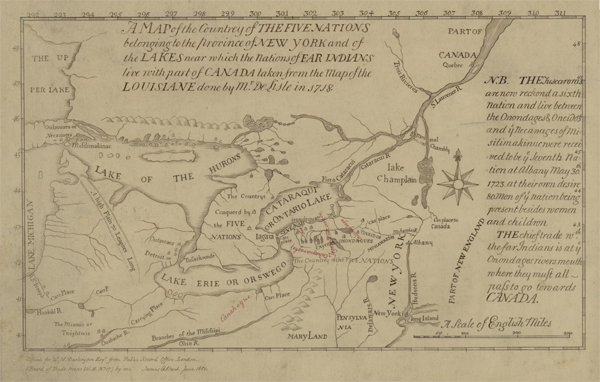
The Iroquois Confederacy, or League, consisted of five tribes living in upper New York State: the Mohawk, Oneida, Onondaga, Cayuga and Seneca tribes. The Iroquois War (1642-53) was a territorial expansion carried out by these tribes to displace the Hurons, the Tabacco Indians, Neutral Nations, the Eries, Conestogas, and Illinois. The Tuscarora tribe joined with the Confederacy in 1722 to become known as the Six Nations.
The Native Peoples around Lake Erie were among the tribes that fell victim to the Iroquois Confederacy. The neutral nations of the Niagaras, living north of Lake Erie, and the Eries, whose country was predominantly south of the lake, were completely destroyed before European explorers ever visited Lake Erie.
The Buffalo, N.Y., area (far east end of Lake Erie) was once dominated by Seneca, Onondaga and Cayuga, all members of the Five Nations. Treaties were attempted among the various tribes in that area but usually ended violently. During the 1700s the Lake Erie frontier became known by many as a region of terror, with many violent confrontations between Native Peoples and European visitors.