
Water levels are part of the ebb and flow of nature. Learn about the three types of water level fluctuations, how levels are measured on the Great Lakes, and what's causing the recent drop.
Water levels are part of the ebb and flow of nature.
The difference between the amount of water coming into a lake and the amount going out is the determining factor in whether the water level will rise, fall or remain stable. When several months of above-average precipitation occur with cooler, cloudy conditions that cause less evaporation, the levels gradually rise. Likewise, prolonged periods of lower-than-average precipitation and warmer temperatures typically result in lowering of water levels.
The recent decline of Great Lakes' water levels, now at lows not seen since the mid-1960s, is due mostly to evaporation during the warmer-than-usual temperatures of the past three years, a series of mild winters, and below-average snowpack in the Lake Superior basin.
Because the major factors affecting the water supply to the lakes--precipitation, evaporation and runoff--cannot be controlled or accurately predicted for more than a few weeks into the future, the influence of man-made regulation of lake levels is very limited. Nature has most of the control, adding water through snow and rain, and taking it away through evaporation.
Three types of water level fluctuations
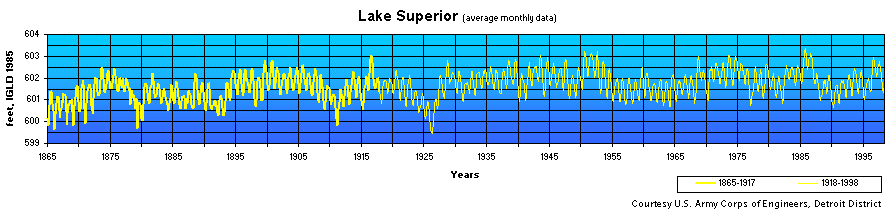
Water levels on the Great Lakes change seasonally each year and can vary dramatically over longer periods. Short-term changes are generally of greater magnitude than the monthly averages.
How levels and flows are measured
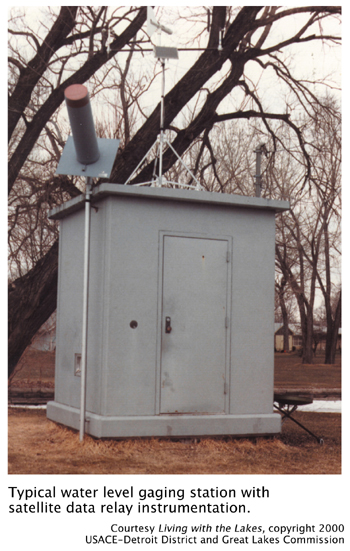
Water levels are measured and recorded at many locations around the Great Lakes and on their connecting channels.
Effects of lake level fluctuations
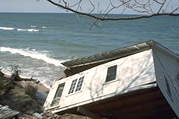
Stretching more than 9,500 miles, the shores of the Great Lakes are constantly reshaped by the effects of wind, waves and moving water. Erosion is a natural process that occurs under all water level conditions, although it is often magnified during periods of high water or storms.