
Six hundred million years ago, during the Paleozoic Era, central North America was covered by a shallow sea. This sea deposited a lot of sand, salts, and silts, which, after time, were compressed into limestone, sandstone, shale, halite, and gypsum.
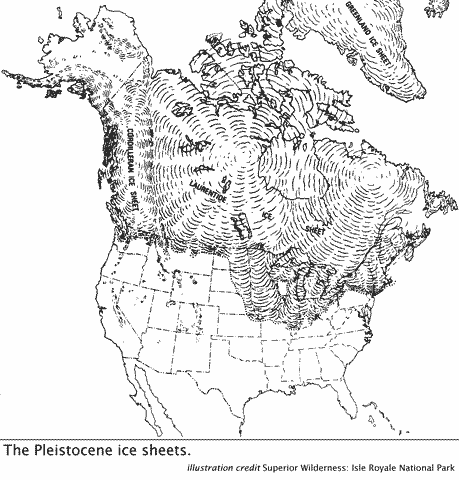
The sea retreated from the Great Lakes region before the end of the Paleozoic Era. Eventually, the earth cooled, and during the Pleistocene Epoch, about 1 million years ago, the ice ages began, and glaciers advanced and retreated many times over what is now the Great Lakes region. Being over one mile thick, these glaciers flattened and carved large holes in the land. Where they encountered more resistant bedrock, such as volcanic deposits, only the overlying layers were removed; but, the softer sandstone and shale allowed the glaciers to dig out the large basins that make up the Great Lakes today.
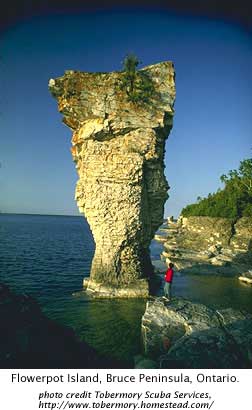
As the glaciers melted and began receding, their leading edges left behind high ridges and fascinating rock formations, some of which can be seen today in the cliffs of Door County, Wisconsin, and the "flowerpots" on Bruce Peninsula in Ontario.
Huge lakes formed between these ridges from the retreating ice fronts. As many as 8-12 ice ages occurred, each lasting around 50,000 years; during the longer, warmer periods in between each ice age, plants and wildlife returned to the area.
The last glacier began retreating around 14,000 years ago, and the earth warmed considerably. As the glaciers melted, the resulting water, called meltwater, filled the huge holes left by the glaciers. During this time, the lakes were much larger than they are now, and they had different river outlets. But as the ice retreated, the St. Lawrence River Valley revealed itself as the outlet to the Atlantic Ocean, and the lake levels eventually dropped to current levels.