Welcome to Story Edventures!
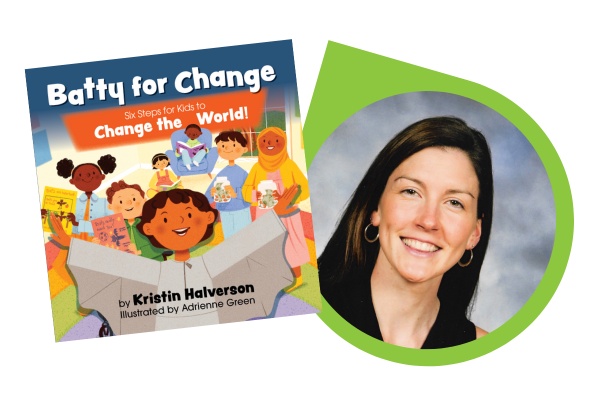
Batty for Change by Kristin Halverson might just inspire you to find a topic, learn everything you can about your topic, decide on an action, and ACT! But first . . . let's explore bats!
Connect
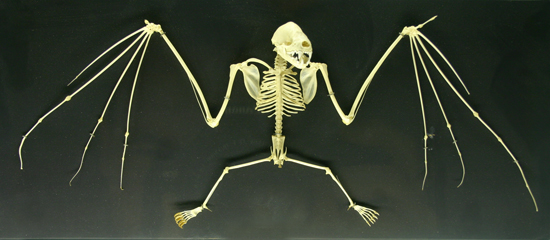
Bats are extremely cool animals. They are the only flying mammals. (Flying squirrels can't fly; they are just really good gliders!) Bats belong to a special group of animals called Chiroptera (ki-ROP-ter-a), meaning "hand-wing." The wing is a double membrane of skin stretched between the extra long bones of four fingers. It extends along the body from the forelimbs to the hind limbs to the tail.
Find out more bat facts
Meet Wisconsin's bats. There are eight different species of bats in Wisconsin. Four species are cave bats that spend the winter in caves and mines. The other four species are tree bats that migrate south for the winter. You can find more about them here.
Explore
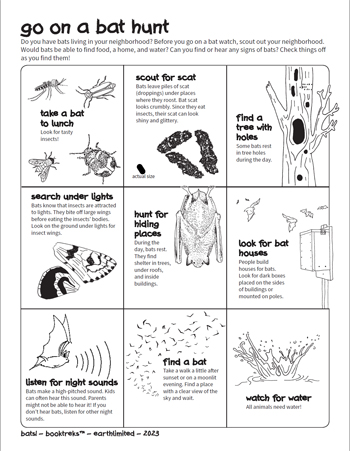
Are there any bats living in your neighborhood? Like all animals, bats need food, water, and shelter. Go on a bat hunt to see what you can find. Click on this thumbnail for a printable hunt sheet.
Engage
Invite bats to your neighborhood. There are some simple things you can do that will help bats. Can your family or school take on any of these projects?
- Plant native plants that will attract tasty insects that bats need to eat.
- Avoid using herbicides and pesticides.
- Make your yard as dark as possible.
- Keep pets indoors.
Build a bat house. All bats need safe places to rest, and mother bats need safe, warm places to raise their babies. As natural habitat disappears, bat houses provide safe places. Be sure to follow all directions related to construction and installation. Ask a grownup to help find plans, purchase materials, build the box, and put it in a good spot.
ACT! Do you like bats? Would you like to think of other ways to help them? Or would you rather choose a different topic to research. Pick something that fascinates you and get to work! Need more inspiration? Check out what these kids did!
- Check out how the Purdy Green Team helps the environment at their school, including turning off electronics and recycling.
- Autumn Peltier, a 16-year-old from Wiikwemkoong First Nation in Ontario, speaks up and fights for clean drinking water in Canada's Indigenous communities.
- At the Young Activists Summit, Vanessa Nakate speaks of starting her climate justice campaign by standing outside Uganda's parliament.
Download the Batty for Change teachers' guide or purchase the book
Discover your bat neighbors. Visit the Wisconsin Bat Program monitoring webpage. (Leaves EEK!) Chose a year. On the next page, find the monitoring route closest to your location. From here, you can view the map to identify the bats that live nearby.
Borrow a bat education trunk from Wisconsin Center for Environmental Education. (Leaves EEK!
Build a bat house! Visit the Wisconsin Department of Natural Resources for bat house plans . (Leaves EEK!)
Visit Bat Conservation International for free bat house plans. (Leaves EEK!) Choose a design and build it!
Buy a bat house. Be sure that it meets the bats' needs. It should:
- Be at least 24” high x 16” wide so the inside of the bat house stays the right temperature for the bats.
- Have a landing pad made of rough wood so the bats have a place to hold on.
- Not have any fabric or mesh.
Plant a bat garden. Well, you can't actually grow a bat, but you can create a bat-friendly space. Visit Bat Conservation International for bat gardening tips. (Leaves EEK!)
Check out the Bat Garden Guide for more detailed information.
Symbolically adopt a bat or ______. Check out Bat Conservation International for adoption information. (Leaves EEK!). Looking for something different? There are many possibilities!
- Adopt a Crane through the International Crane Foundation.
- Adopt an Eagle or Adopt a Loon through the National Audubon Society.
- Adopt a Monarch Butterfly or Adopt a Peregrine Falcon through the National Wildlife Federation.
- Adopt a Fish or Wildlife Area through the Wisconsin Department of Natural Resources.
Books, books, books! Consider supporting nature-based authors, many with roots in Wisconsin or the Midwest, by adding featured Story Edventure books to your home, school, or community libraries. If you purchase from our Bookshop a percentage of your purchase will benefit FIELD Edventures. (Leaves EEK!)
Batty for Change Book References (all of these links leave EEK!):
- Bat Conservation, 2019. “International Certificate of Adoption for Bechstein’s Bat and Mexican Free-Tailed Bat.”
- “Guide to Gardening for Bats.” Last accessed 10/6/23.
- Bat Conservation International. “Bats 101.” Last accessed 10/6/23.
- Cotterill, Madigan. “No bats, no chocolate—plus five more reasons you should love bats.” Canadian Geographic. October 27, 2022. Last accessed 10/6/23.
- Kid Conservationist. Dalton, Jack. Last accessed 10/6/23.
- Make a Change World. “Bali becomes the first Indonesian island to ban single use plastic bags, straws, and polystyrene.” Last accessed 10/6/23.
- National Park Service. “Made Possible by… Bats.” Last accessed 10/6/23.
- United Nations. “Meet 23 Young People Leading Resilient Recovery in the Decade of Action—Melati Wijsen & Isabel Wijsen.” Last accessed 10/6/23.
- U.S. Department of the Interior. “13 Awesome Facts About Bats.” Last accessed 10/20/21.
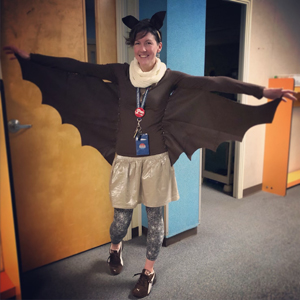
About the author
Kristin is a former early childhood and elementary teacher and National Board-Certified Educator. She holds a B.S. in Natural Resources and Environmental Education with a master's degree in Elementary and Early Childhood Education and certifications in Reading as well as a National Geographic Educator Certification. She is passionate about teaching young children the value the natural environment provides and how to advocate for themselves, for others, and for the environment.