Welcome to Story Edventures!
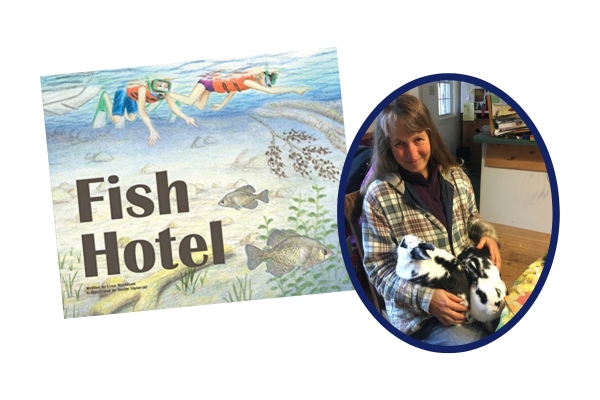
Fish Hotel by Lynn Markham takes you on an aquatic edventure to the underwater world of Wisconsin lakes and rivers. In this book, you will learn along with the main characters, cousins Tessa and Hugo, about the importance of fish habitat and how to create it. Fish enthusiasts and water explorers will be drawn to this edventure by the mystery of this underwater world.
Connect
Get your feet wet exploring one of Wisconsin’s 15,000 lakes or some of our 13,500 miles of navigable streams and rivers! Wading, swimming, boating, and paddling are great ways to get out on the water. What will you discover?
- Start by reading aloud the book Fish Hotel.
- If you live in Wisconsin, you probably live fairly close to water! Go to google maps to find local public beaches, parks, or boat landings. Talk with your grownups about visiting them.
- Once there, notice the aquatic ecosystem. What plants, animals, birds, insects, invertebrates, and fish can you see?
You can also connect at home to get ready to explore outside! Check out this amazing underwater video created by Eric Engbretson! It is one of many fish-watching videos on his YouTube Channel.
Explore
There are plenty of things to explore when it comes to aquatic ecosystems! With safety as your first priority, check out this incredible underwater world. Expect to get a little (or a lot) wet, depending on your method of travel. Tessa and Hugo decided to explore with a snorkel and mask. You could choose to wade, swim, paddle, or ride in a boat! What do you wonder about the various plants, animals, birds, insects, invertebrates, and fish you see? Compare these creatures to a non-aquatic location such as a forest or field.
Other ways to explore:
- Find a Sit Spot. Pick a location and try to sit still for 5-10 minutes. Record what you notice about the aquatic ecosystem. Repeat at the same location for a week or each week throughout the season. As spring approaches, study spring phenology in the wetland!
- Record and collect data. Use nets to collect aquatic macroinvertebrates in your local waterways. Record the date, time, location, weather (temperature, wind speed and direction, and cloud cover). Use tally marks to record how many of a certain species you find. Use this data to determine the overall health and needs of that water body.
- Practice using I notice…, I wonder…, It reminds me of… as you soak up the biodiversity of these incredible and incredibly important ecosystems.
- Go fishing. Study the life cycle and habitat needs of native fish in your local lakes and rivers. Research the history of area fisheries. Find out more about Fish Watching in Wisconsin.
- Follow the water. Surface and ground water are connected! Find out where rain and snow that falls on your backyard ends up. In Wisconsin, we have three main watersheds: Lake Superior, Lake Michigan, and the Mississippi River. Trace the flow of water in our state by studying maps. How does this relate to pollution and runoff?
Engage
Just like Tessa and Hugo, the more they learned, the more they wanted to make changes to help their lake! You can help, too! Our Wisconsin rivers and lakes are at risk of pollution, invasive species, and habitat loss. They need everyone's help! Here are some ways you could help:
- Join a spring clean up. Most litter eventually ends up in a river or lake, harming aquatic organisms. Do your part by: not littering, properly disposing of oil, old paint, and other harmful liquids, recycling (including electronics), and picking up garbage. If there isn't a community clean up in your area, could you start one?
- Raise awareness. Help your community understand the importance of protecting local waterways by writing a short story, poem, or article for your local newspaper. Put up signs around town about littering, important habitat areas, projects.
- Protect storm drains. Check out how some communities have turned their storm drains into Community Art Projects that raise storm drain awareness!
- Adopt a shoreline. Restore a shoreline in your area by working with landowners or park departments. Begin by researching what a healthy shoreline in your area looks like. Talk with specialists to make a plan to remove invasive species and plant native trees, shrubs, and perennials. Keep good records about what you did by collecting and recording data!
About the author
Lynn Markham, is a Shoreland Specialist with Wisconsin Extension. She helps Wisconsin communities who want to protect lakes, streams, and drinking water...which are all connected. Lynn has written lake books for big people and little people. She loves swimming, snorkeling, and exploring lakes with her kids, Tate and Tessa. Check out her other book readings, including Fish Hotel and Magic Goggles. Lynn also has a wonderful field journal and mini-book on Fish Hotels that go along with her books.
Fish Hotel Kits. UW-Stevens Point Center for Land Use Education produced teaching materials to help educators extend the story! Visit Fish Hotel Kits for more information, links to videos and PowerPoint presentations, and other resources. You will also find a teaching guide here. (Leaves EEK!)
More about shorelines. Learn how Shoreland Zoning helps protect water quality, fishing, and home values in a short animated video from the Center for Land Use Planning. (Leaves EEK!)
Places to visit. To locate public lands that your family can visit and explore, open Wisconsin DNR’s Public Access Mapping Application. (Leaves EEK!)
Local water projects. Visit the WI Land and Water Conservation Association to learn more about local water projects. (Leaves EEK!)
Books, books, books! Consider supporting nature-based authors, many with roots in Wisconsin or the Midwest, by adding featured Story Edventure books to your home, school, or community libraries. If you purchase from our Bookshop a percentage of your purchase will benefit FIELD Edventures. (Leaves EEK!)