Common name: spiny softshell
Scientific name: Apalone spinifera
How to identify them
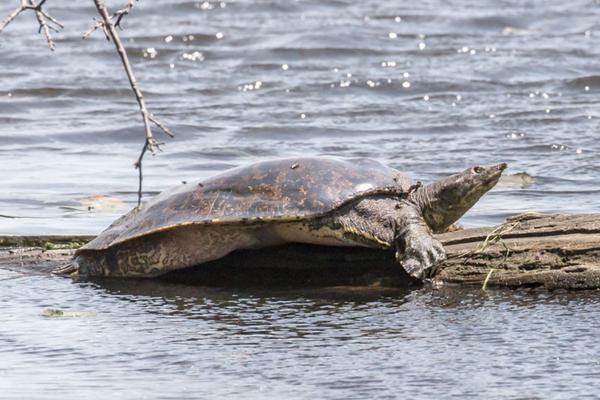
The spiny softshell looks a lot like its relative, the smooth softshell, but there are some differences. The spiny softshell has:
- A row of spines along the front edge of the carapace (top shell)
- Two yellow, black-bordered lines along each side of its head
- Nostrils in the shape of a "C"
- An attitude! Spiny softshells are often more aggressive when handled, and they can bite hard! So, take care not to handle these critters.
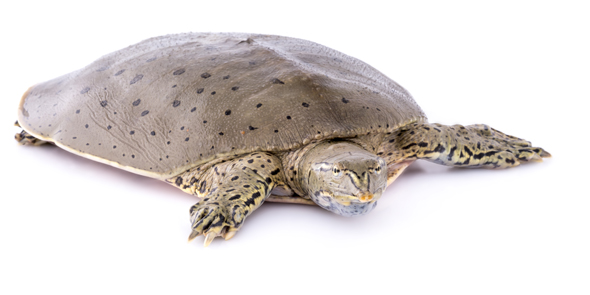
Young turtles and male turtles have olive-gray carapaces with small black markings that often look like a thin donut. Adult females have dark olive or tan carapaces with brown and gray mottling.
Where they live

These turtles can be found in large rivers, lakes, and reservoirs, especially those with muddy or sandy bottoms. Check out the map. The darker brown shaded areas show where spiny softshell turtles live in Wisconsin.
These turtles seek out sandy beaches for nesting sites. Young turtles spend a lot of time buried under the bottom mud or sand in shallow water, especially at night. This keeps them hidden when they're not active.
What they eat
They feed on fish, invertebrates, mollusks, carrion (dead stuff), and plant material.
Did you know?
Spiny softshells have two ways to breathe. When their nostrils are out of the water, they breathe oxygen from the air into their lungs. However, when they are underwater, the linings of their cloacas (anal openings) and their mouths and throats can absorb oxygen that is dissolved in the water!
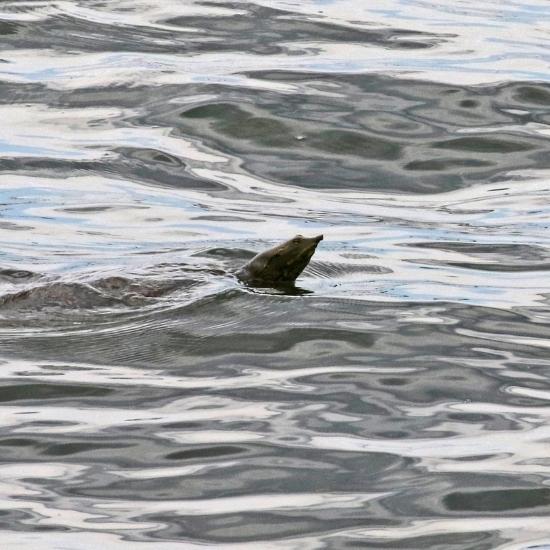
When you are looking for softshell turtles, watch for just their noses sticking out of the water.