Discover the Great Lakes
The Great Lakes include, Superior, Michigan, Huron, Erie, and Ontario. These lakes form the largest fresh water system on earth. They are North America’s greatest natural resource.
What are the Great Lakes?
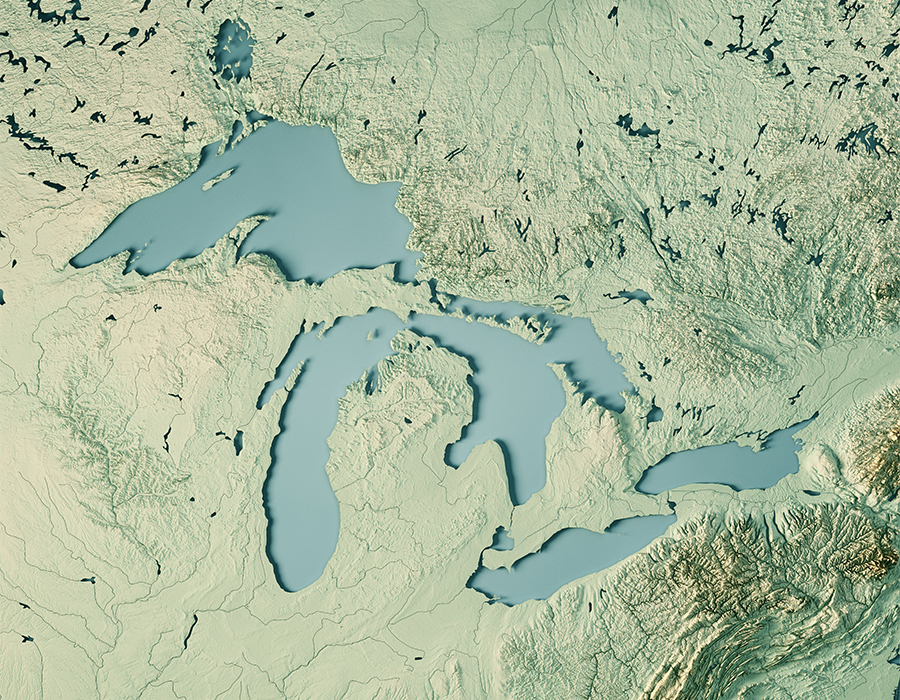
The Great Lakes—Superior, Michigan, Huron, Erie, and Ontario—and their connecting channels form the largest fresh surface water system on Earth. If you stood on the moon, you could see the lakes. You could point out the wolf-head shape of Lake Superior and the mitten bounded by lakes Michigan, Huron, and Erie.
The Great Lakes, in their current state, are actually one of the youngest natural features on the North American continent. Covering more than 94,000 square miles and draining more than twice as much land, these Freshwater Seas hold an estimated 6 quadrillion gallons of water, about one-fifth of the world's fresh surface water supply and nine-tenths of the U.S. supply.
Great Lakes system
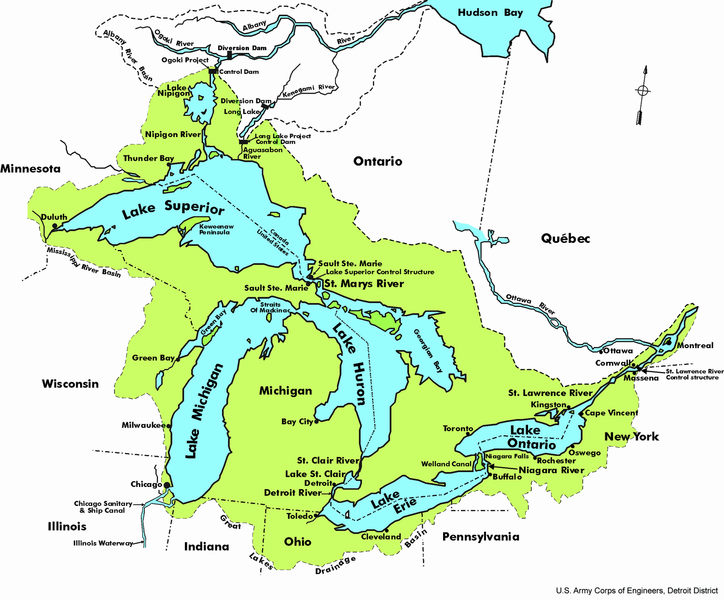
The Great Lakes system includes the five Great Lakes, Lake St. Clair, and the connecting channels, along with many harbors and bays. Each lake has distinctive basin features, circulation, and ecology. The Great Lakes, their respective watersheds and waterways, and the ocean are all connected. Within the Great Lakes system, water flows from Lake Superior and Lake Michigan to Lake Huron, through Lake St. Clair into Lake Erie, over Niagara Falls and into Lake Ontario before flowing through the St. Lawrence River into the ocean.
Great Lakes watershed
The Great Lakes watershed includes part or all of eight U.S. states (Minnesota, Wisconsin, Illinois, Indiana, Michigan, Ohio, Pennsylvania and New York) and the Canadian province of Ontario. Rivers and streams transport nutrients, dissolved gases, salts and minerals, sediments, and pollutants from watersheds into the Great Lakes. Today, more than 33 million people inhabit this drainage basin: more than one-tenth of the population of the United States and one-quarter of the population of Canada.
- Most of North America's fresh surface water (95%) is in the Great Lakes.
- Spread evenly across the contiguous 48 states, the lakes' water would be about 9.5 feet deep.
- All five of the Great Lakes are among the world's 18 largest lakes by area and volume.
- The Great Lakes and islands within them have more than 10,000 miles of coastline, longer than the East coast of the United States.