
Adopt a quarantine tree!
Trees are a joy to adopt—they grow, provide shade in summer, and you generally don't have to feed them! In this instance, we're talking about picking out one specific tree, learning by observing what we can about its growth, health, and seasonal cycles, and making connections between trees and people.
Connect
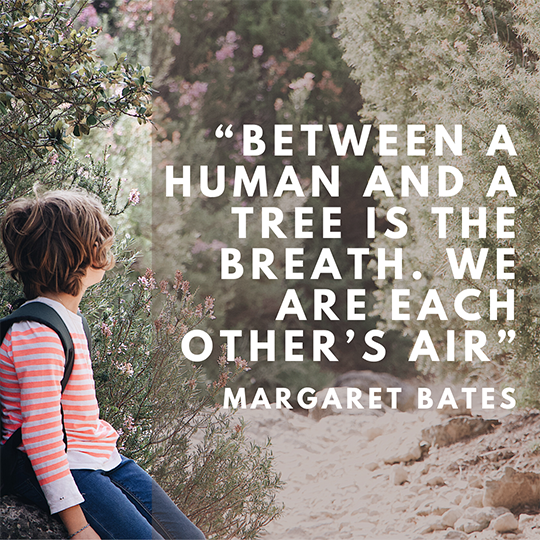
Shared Breathing
Find a tree. Stand a couple feet from its trunk. Take a moment to observe the tree. Follow the trunk with your eyes up to the sky. Observe the branches spreading outwards. Notice the leaves absorbing the sunlight. Breathe deeply. Imagine that the oxygen from the tree is entering your lungs. Now breathe out, giving the carbon dioxide back to the tree. Breathe in and out several times, thinking about how you and the tree are interconnected.
Adapted from The Sky and Earth Touched Me, Joseph Bharat Cornell
Explore
Tag along with Rachel Feerick, the Riveredge Nature Center Scientist in Residence for the West Bend School District for this #RiveredgeVirtualNaturalist experience as she shares what her thoughts and observations while adopting a tree in her backyard.
In your Nature Notebook record the date, time, temperature, weather, and your tree's location.
Start by describing your tree. What do you notice about it? What do you notice when you stand far away? What do you notice when you stand close by? What can you observe that makes tree different than other trees around it? What do you wonder when you think about your tree? What does your tree remind you of?
Describe the bark. Use your senses to explore the bark. Record your noticings in your nature notebook. What do you wonder about when you think about the bark? What does the bark remind you of? If desired, lay a piece of paper on the bark. Use the edge of a pencil or crayon (peel off paper) and lightly rub over the bark to capture the texture of the bark in your journal and reveal details you might not notice just by looking at it.
Look closely at the branches, if you can reach them. Challenge yourself to notice 5 different things about the tree's branches. What do you wonder about when you think about the branches? What do they remind you of?
Remember to look down! What do you notice about where the tree and the ground meet? What do you notice about the roots? What questions do you have about the trees roots and the base of the tree? What do they remind you of?
Reflect on your experience:
- What did you notice about your time outdoors today? How was it different than the last time you were out there? How was it similar?
-
Did you notice anything about your tree that was unusual or caused you to ask a question about it? What do you think is the explanation for what you observed? What do you think caused it to be like that?
-
Think about your relationship with trees. How do you support trees? How do they support you? Write down as many connections as you can. Need some ideas? Watch this “Gifts from Trees” music video or find out why we celebrate trees every year with Arbor Day.
- What changes to your tree might you observe during this time at home? How might you change during the same time period? How might your tree change during your lifetime? How will you change during your lifetime?
Engage
- Learn more about trees that live in Wisconsin.
- Discover why leaves change color.
- Find out how your tree measures up to Champion Trees.
- Get crafty with leaf printing.
Share your learning
Describe your tree to someone else. See if they can find it from your description. Create a piece of artwork about your tree or write a poem or story about it. Check out these books for inspiration! Submit your work to EEK!
This exploration was adapted from Project Learning Tree, LEAF Wisconsin K-12 Forestry Program, and BEETLES Project with support from River Edge Nature Center and School District of Waukesha Environmental Education staff.