
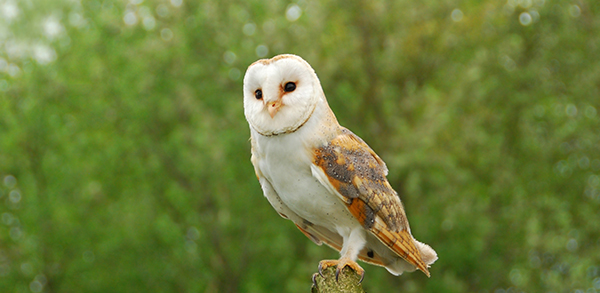
This graceful but ghostly bird can locate a mouse in the dark of night by sound alone without the aid of external ears. Barn owls don't have ear "tufts" like great horned owls or screech owls. They have ear openings hidden behind their round facial disk of feathers. The feathers help direct sound into the ears.
Barn owls are one of Wisconsin's best natural mousetraps, consuming one and-a-half times their weight in food each day! That's like a 100-pound person eating 150 pounds of food. Look out mice, meadow voles, shrews, and other small animals. Some modern agricultural practices have reduced barn owl habitat by shifting from cover crops such as oats and hay to row crops like corn. This removes food and shelter for mice and voles. The owls then lose their local food source. Barn owls have a hard time surviving severe winters if they can't find enough food, since their bodies store little fat reserves. Typically they hunt along uncultivated field edges, fence rows, and wetland edges. On average, barn owls only live 3-4 years.

Their unforgettable shriek or hiss-screams not only warn their young of danger, it is sure to scare off any predator or human bystander. You may hear this sound in the spring or late summer as the owls look after their young. The young owls are reared in tree cavities, abandoned buildings, church steeples, silos, or as their name suggests, barns. Adults lay one egg every 2 days on a bare surface in a dark corner until there are 5-7 eggs. The eggs hatch about 30 days later; one at a time.
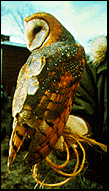
Unfortunately, most of their nesting sites are disappearing in Wisconsin as modern, windowless metal farm buildings replace barns with open windows and cracks and as large, dead nesting trees are removed from woodlots. The barn owl can be found all over the United States, except for the very northern states. They are rare in Wisconsin, usually found in the southern one-third of the state. You can help barn owls out by reporting any barn owl sightings.