
Invasive species and their impacts on the native fishery
Many commonly known Great Lakes fish, including chinook and coho salmon and rainbow trout, are actually non-native species that have been introduced to the lakes, either accidentally or intentionally.
When a species is introduced into a new habitat it lacks natural controls on its population; predators, and competitors are absent and prey don't know how to avoid them. Without these natural controls, populations of introduced species often explode. Examples of such introduced aquatic species in the Great Lakes include carp, zebra mussels, sea lamprey, goby and ruffe.
Perhaps one of the most notable accidental introductions was that of the sea lamprey (Petromyzon marinus) to the majority of the Great Lakes, between 1936 and 1946. This large, parasitic lamprey feeds on commercially important species such as whitefish and lake trout. Lamprey victims either die, or are no longer valuable because of the ugly scars left behind by the lamprey's "suction-like" mouth. The sea lamprey continues to be a problem in the Great Lakes and is the focus of much research.
The most serious problems that introduced, non-native species cause are competition and hybridization. Competition for food and habitat is difficult to prove, but is believed to be the cause of population declines of native fish in some situations. Hybridization results when an introduced species mates with a native species producing hybrid offspring. If native species are rare, they are more likely to encounter, mate and reproduce with the invading species than with their own species. This can ultimately lead to the extinction of the native species.
Related TEACH module: Non-native invasive species in the Great Lakes
At risk species...
Several once commercially important fish, such as the cisco and the blue pike, have become extinct while populations of non-native invasive species have increased. The first fish to feel the pressure of the commercial fishery was the Atlantic salmon. By 1860, overfishing and loss of prime spawning habitat caused this popular, high-value fish to become endangered in the Great Lakes. Despite restocking efforts, today the Atlantic salmon is believed to be extinct.
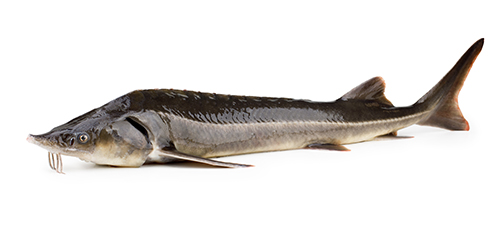
The once common lake sturgeon is also very rare today. The lake sturgeon was once so abundant in the Great Lakes that it was considered a nuisance. However, advances in the smoking and processing industries created a market for smoked sturgeon meat and caviar. Sturgeon were then overfished, and by 1900 populations could no longer support a commercial fishery. Today, these immense fish -- sometimes up to 6 feet (1.8 meters) in length -- are very rare in deep waters of the Great Lakes.
Related sites:
- Sea Lamprey control, Great Lakes Fishery Commission
- The Sea Lamprey: No bones about it!
- About the Lake Sturgeon
- Great Lakes Lake Sturgeon Page
Threats to species are everywhere. In the United States alone, 37 percent of freshwater fish species are threatened or have become extinct. Some extinct Great Lakes fish species. These species no longer exist on Earth!
Blue pike (Stizostedion vitreum glacum)
- Formerly found in lakes Erie and Ontario
- Declared extinct in 1983
Deepwater cisco (Coregonus johannae)
- Formerly found in lakes Huron and Michigan
- Extinct in 1960s
Harelip sucker (Lagochila lacera)
- Formerly seen in clear streams of the upper Mississippi Valley, and the Lake Erie and Ohio drainage basins
- Not seen since 1900
Longjaw cisco (Coregonus alpenae)
- Formerly found in lakes Erie, Huron and Michigan
- Declared extinct in 1983
Shortnose cisco (Coregonus reighardi)
- Formerly found in lakes Huron, Michigan and Ontario
- No individuals collected since 1985