
In the Great Lakes region you'll find the largest continuous mass of freshwater in the world. In fact, these lakes, shared by the United States and Canada, have supported one of the world's largest freshwater fisheries for more than 100 years.
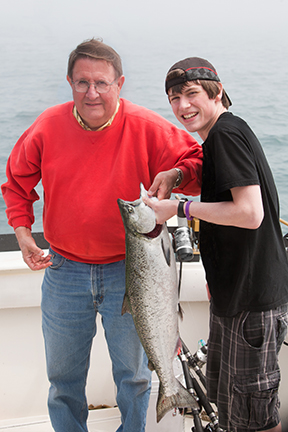
The Great Lakes fishery consists of a blend of native and introduced species, some of which are regularly restocked. Common catches include lake trout, salmon, walleye, perch, white fish, smallmouth bass, steelhead and brown trout. The greatest commercial fishing harvests were recorded in 1889 and 1899 at about 147 million pounds (67,000 metric tons). Since then, the fishery has been threatened on three fronts: overfishing, pollution and non-native invasive species. Recent years have seen a major resurgence as walleye fisheries recover in Lake Erie, trout populations become more self-sustaining in Lake Superior, and new salmon fisheries develop in Lake Ontario. Fishery researchers estimate that 25 percent to 40 percent of the salmon and trout populations in lakes Michigan, Huron and Ontario are now self-reproducing, crediting improved habitat, water quality and stream conditions.
Each of the Great Lakes has its own mainstay species. In Lake Superior, the largest of the lakes, lake herring, rainbow smelt, lake whitefish and yellow perch are of commercial importance. In Lake Huron, lake whitefish is the primary catch, while yellow perch, salmon and walleye support the fisheries in lakes Erie and Michigan. Erie remains the most productive of the Great Lakes. The Lake Ontario fishery has declined somewhat due to pollution; in past years the main species harvested were the American eel, yellow perch, bullheads, sunfish and rock bass. Today, salmon, trout and smallmouth bass fishing in Lake Ontario is said to be the "best in years." Yellow perch remains a primary catch in all of the Great Lakes.
The region's inland waters offer many fishing opportunities, as well. Blue-ribbon trout streams attract fly fishing enthusiasts, and lakes offer a variety of fish, including crappie, bluegill, perch, pike and large- and small-mouth bass. The commercial and sport fishery on the Great Lakes is collectively valued at more than $4 billion annually and supports thousands of jobs, including many in the processing and packaging industries.