
What are the causes of urban sprawl?
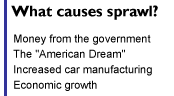
After World War II, people started moving from the cities into the countryside. The GI Bill, road building projects, and increased car manufacturing all contributed greatly to this shift, and living in "suburbia" signified a better quality of life. Land was cheap and there was plenty of it, and government incentives and subsidies helped families realize their dream. Today, subsidies from the federal and state governments, such as for highway construction and commercial development, continue to promote sprawl and its effects.
The lack of effective land use planning allowed this move to the countryside to occur virtually uncontrolled. All Great Lakes states allow local governments to create comprehensive plans to guide growth and to create local laws (called zoning ordinances) to decide what types of development can happen where. However, none of the Great Lakes states actually require local land use planning.
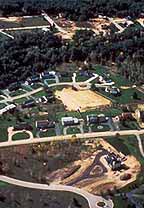
In all of the Great Lakes states, land use planning happens at the smallest level of government (e.g., town, township, city), so the state has very little say in how land gets developed, except when it involves spending state tax dollars, such as for major highway projects. When local land use plans are developed, often they are inconsistent with the zoning ordinances and do not consider the impacts on surrounding areas and nearby communities. In practice, zoning ordinances and building codes, not land use plans, govern most land development decisions. The problem with this is that zoning tells "where" and "what type" of development can take place, but it does not consider questions of "how" and "when" development should take place. Most zoning ordinances separate different types of land uses, establish minimum distances between houses, minimum setbacks from roads, minimum parking space requirements, minimum road widths, and so on so that the only type of development that can occur is sprawl. In this way, the lack of land use planning and the reliance on zoning ordinances has promoted sprawl.
With little or no land use planning to protect greenfields, farm fields and rural countrysides and ecologically important habitats such as wetlands have been carved up. More roads were needed to connect the new developments to downtown, which invited more development on the outskirts and the cycle continues today. As more people and businesses move out to former greenfields, fewer taxpayers are supporting older towns and cities, leaving them to deteriorate.
What are the effects of urban sprawl?
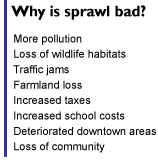
According to a 1998 Sierra Club report, cities in six of the Great Lakes states account for six of the top 20 sprawl threatened cities (over one million residents) in the United States: Cincinnati, Minneapolis-St. Paul, Chicago, Detroit, Cleveland and Pittsburgh. In Chicago, for example, the population increased only 9 percent from 1990 to 1996, but land area development has increased more than 40 percent in that same time period. In Michigan, over 100,000 acres of farmland are lost to urban sprawl every year. And the amount of time Cincinnati drivers were stuck in traffic jams increased 200 percent from 1982 to 1994.

Sprawl can damage ecological systems and their natural functions, such as wildlife habitats and wetlands. Housing subdivisions, commercial developments, and the roads that connect them all divide a landscape, which results in habitat fragmentation. This fragmentation forces wildlife to either find another place to live or compete with each for a smaller amount of land. Urban sprawl is also threatening wetlands, an important key to healthy ecosystems. In addition to being home to a number of critical wildlife and plant species, wetlands improve water quality by filtering out sediments and other pollutants, protect the shorelines of rivers and lakes from erosion, and help control and reduce flooding. However, since 1800, over two-thirds of Great Lakes wetlands have been lost or severely damaged, and land development continues to destroy wetlands today.
Pollution is also a cost of urban sprawl. Most sprawling towns are built for cars and force us to drive more frequently and for longer periods of time. And increased use of cars leads to more air and noise pollution as well as traffic jams. As for water pollution, lands covered with highways, buildings, and parking lots increases runoff, polluting our streams, lakes, and watersheds. As a result, our access to clean and safe drinking water becomes threatened, and our aquatic plant and animal life suffer.
Urban sprawl is also destroying our farmlands at an alarming rate. Between 1981 and 1992 the Great Lakes basin lost more than 4.5 million acres of farmland, an area nearly the size of Lake Ontario. This loss of farmland decreases our access to an affordable food supply and sacrifices open lands to development and, eventually, more pollution. According to the American Farmland Trust, of the top 20 threatened farmland regions in the U.S., five of them are in the Great Lakes region -- Southern Wisconsin and Northern Illinois Drift Plain, the Eastern Ohio Till Plain, the Ontario Plain and Finger Lakes region, the Southwestern Michigan Fruit and Truck Belt, and the Western Michigan Fruit and Truck Belt.
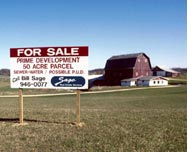
Sprawl inevitably raises taxes. New urban infrastructure such as roads and sewer and water lines is expensive, and taxes help pay for the expense of establishing suburban communities. But as is often the case, taxpayers from a broader geographic area help pay for new development, so people who do not live in these suburban communities are often burdened with higher taxes as well. One hidden cost of sprawl is the construction of new schools. As communities spread out, new suburban schools must be constructed, often leaving urban schools under-utilized and poorly funded. Between 1970 and 1990, Minneapolis-St. Paul spent tax dollars building 78 new suburban schools, while closing over 150 schools in fine condition within the city limits.
Many cities in the Great Lakes region, such as Detroit, are suffering from the abandonment of businesses and residents, and their downtown areas have fallen into a state of decay. The sense of community afforded by urban areas is lost, and suburban communities often don't provide a substitute, because they are isolated from one another and from community gathering places, such as the town square, grocery store, shopping, and work areas. Citizens remaining in the city are often too poor to move elsewhere, and jobs are scarce because many businesses have moved to the suburbs. These indirect costs are important because they affect the environment, the economy, and the quality of life for both the urban and suburban residents of a city.
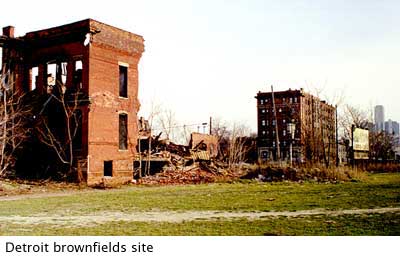
Another problem of deserted downtown areas is brownfields -- potentially contaminated areas on which a deserted building, such as an old industrial facility, still stands. Whatever business or operation polluted the land has now moved on, and no one wants to claim responsibility for the cleanup; the area remains deserted, continuing to pollute the soil and, potentially, the water supply. An indirect cost of brownfields is the development of greenfields. Instead of cleaning up land that has already been developed, developers target undeveloped open space for new development, resulting in more sprawl.