
Common name: ring-necked snake
Scientific name: Diadophis punctatus
How to identify them
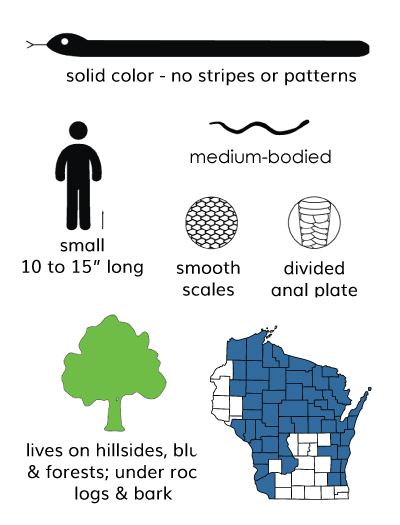
Ring-necked snakes have bright yellow-orange rings around their necks, The tops of their bodies are dark blue or black.
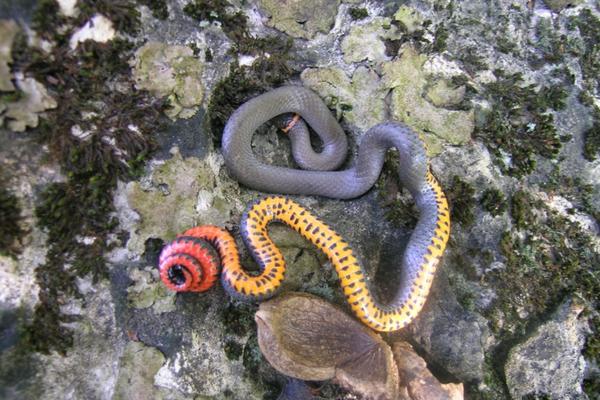
There are two subspeices of ring-necked snakes in Wisconsin, and you can tell them apart if you see their bellies. Prairie ring-necked snakes (Diadophis punctatus arnyi) have yellow-orange bellies. Under their tails, the color becomes bright orange-red. They also have black half-moon spots scattered on their belly scales.
Northern ring-necked snakes (Diadophis punctatus edwardsii) have solid light yellow bellies with no markings.
Where both prairie and northern ring-necked snakes live, they can mate with each other. The bellies of their offspring look like a mixture of their two parents.
Where they live
Prairie ring-necked snakes live in the southwest part of the state in prairies and rock cuts. They often hide under rocks on the south-facing, sunny side of a hill.
Northern ring-necked snakes live in the central and northwest part of the state in moist, deciduous forests.
What they eat
They eat insects, earthworms, salamanders, frogs, and other small snakes.
Did you know?
When threatened, ring-necked snakes coil their tails up and flip them over to show the bright colors. The sudden appearance of a flash of color might distract predators and allow the snakes to escape.