
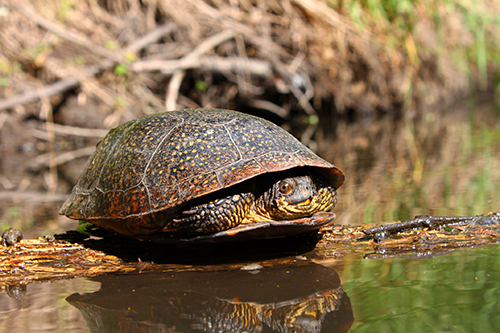
Common name: Blanding's turtle
Scientific name: Emydoidea blandingii
Wildlife watching at a wetland area is a fun summer time activity. Observe frogs calling, river otters swimming, and muskies spawning. You may even spot one of Wisconsin's less common species, the Blanding's turtle. If you see one, move very slowly to get a better peek. Shhhh, or you will scare it back into its shell. The Blanding's turtle is one of nature's most timid creatures.
It's easy to spot an adult Blanding's turtle from quite a distance because of its bright yellow neck and chin. If you get a close look before it zips back into its shell you may see one that appears to have a black mustache.
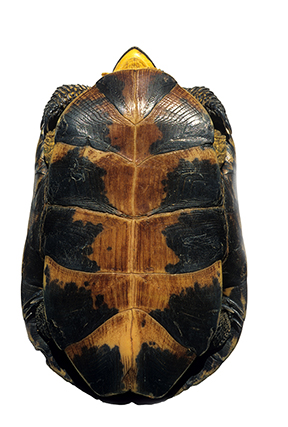
Its head, tail, and legs are blue-black. The upper shell, called a carapace, is smooth and black with speckles of yellow spots and streaks. The underside of its shell, called a plastron, is colored almost the opposite. (see photo) The plastron is yellow with blotches of brown and black. The plastron is hinged across the center and can be pulled up to protect the turtle's head, neck, and legs from predators. This is why you may have heard the Blanding's turtle called a "semi-box turtle." The hinge does not work properly until the turtle is 3 to 5- years-old.
The Blanding's turtle is medium-sized for a turtle. On the average, an adult turtle is 8 to 10 inches long and weighs up to 3 pounds. Male turtles are larger than females and the undersides of their shells are concave (indented) for mating.
It may surprise you to learn that young Blanding's turtles look quite different from adults. Their shells are patterned to blend into the environment and they don't have yellow necks or chins yet. The drabness of the young turtles helps protect them from predators.
The Blanding's favorite food is crayfish but they also feed on snails, insects, frogs, and fish. Unlike most turtles they can swallow food both in and out of water. On land they munch on earthworms, slugs, grasses and berries- yum. During the winter, they hibernate by burrowing in silt on the bottom of a pond, bay, river, or other body of water.
Blanding's turtles mate in the water during early spring. After fertilization female turtles will lounge in the sun with their heads and legs fully extended. This warming behavior, called thermoregulation (thermo = heat), speeds up the development of the eggs so they can be laid sooner. They lay their eggs on sandy ground and will travel up to 1 ½ miles to reach a good nesting area. Each clutch, or nest of eggs, contains from 3 to 17 eggs and takes 65 to 90 days to hatch. Nests are not safe from hungry birds, crows, skunks, and raccoons. The earlier the eggs hatch the more time the young have to grow before hibernation. Eggs have a better chance of hatching if they miss autumn frosts. Hatchlings are about one and a quarter inches long and range from a dark gray to green color. Scientists know very little about the habits of the young because they are so secretive.
The Blanding's turtle is semi-aquatic. This means it likes water but can also be on land at times. It prefers to live in grassy marshes with shallow water. Occasionally it leaves the water and travels on land to search for food or lie in the sun - not to tan, but to stay warm.
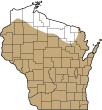
The Blanding's turtle lives in marshes, ponds, quiet streams, and shallow bays. It can be found in wetlands in southern Ontario and northwestern Pennsylvania in the East, through Ohio, Indiana, Michigan, Illinois, Wisconsin, and southern Minnesota, and also Nebraska, Iowa, and northeastern Missouri in the West. In Wisconsin, Blanding's turtles live throughout the state except in extreme north central counties.
Blanding's turtles need both water and land to survive. Wetland areas are disappearing in Wisconsin. In fact, 50 percent of the original wetland areas in Wisconsin have been lost. The loss of habitat has reduced the populations of turtles. Roads are also a hazard for Blanding's turtles. They are barriers to cross for nesting and many turtles are killed by traffic. Thanks for helping to take care of Blanding's turtles and to keep them wild and free.