Common name: Liatris, blazing star, gayfeather
Scientific name: Liatris spp. (the "spp." means that there are several species in the genus Liatris, but we are not going to try to separate them. We are just going to talk about all of them together)
Blazing stars are not something you'll find in the sky! They grow in dry fields, prairies, and dry roadside ditches. Because they are beautiful and easy to grow, you will also find them growing in gardens and backyards!
What do blazing stars look like?
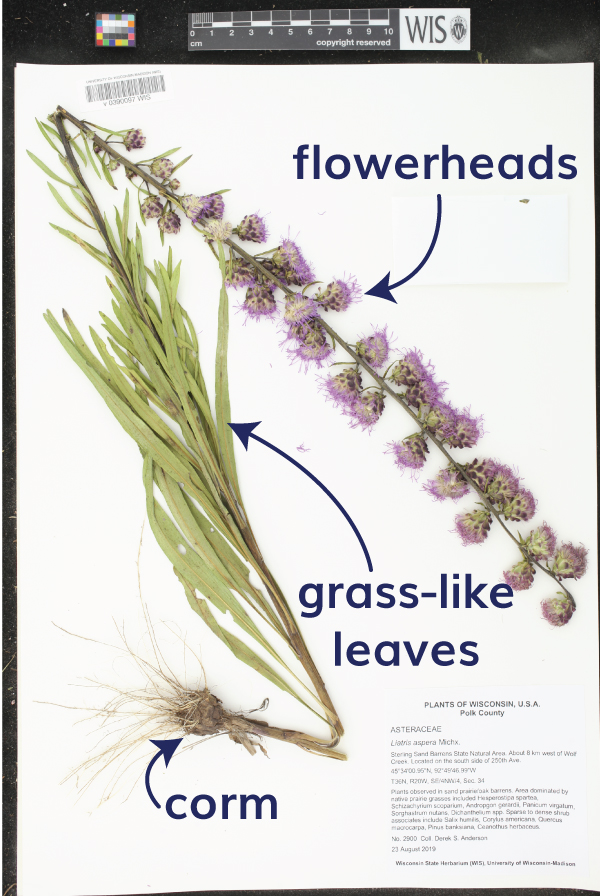
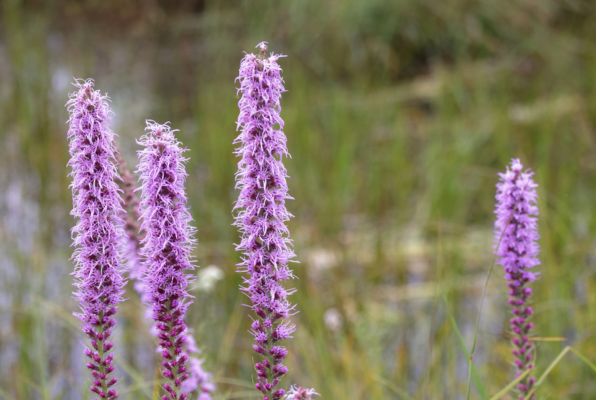
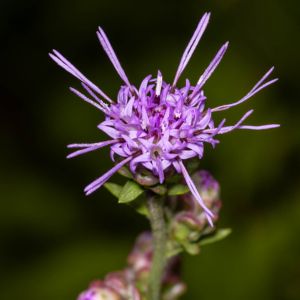
Blazing stars are most easily identified from July through October when they are blooming. Look for flowering spikes! Look closely and you will see that each spike is really made of many small purple-pink flower heads. Each flower head looks like a tiny thistle, and, like thistle, each little flower head is made up of many even smaller flowers.
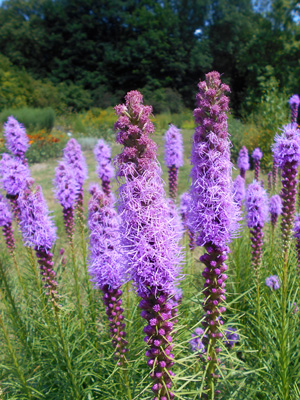
The flowers begin to bloom at the top of the spike. Check out the photo that shows flowerheads that have already bloomed at the top, flowerheads that are in full bloom in the middle, and flowerheads that have not bloomed yet at the bottom.
Why are they important?
Pollinators, like bees and butterflies, love blazing stars!
Did you know?
Blazing star is a perennial flower that grows back year after year. In fall, the leaves turn brown and die. Under the ground, the plant's energy is stored in a corm. A corm works the same as a bulb, but it doesn't look the same. In spring, grass-like leaves emerge from the ground. Notice how the leaves are much larger at the bottom of the plant than they are at the top.