
By Michael Aprill, E.d.D. in Educational Sustainability
The Great Lakes influence regional climate. If you visit one of the Great Lakes you will notice that the weather is much different than inland. The temperature and winds vary from day to night and throughout the seasons.
Large bodies of water such as the Great Lakes store a lot of energy in the form of heat. A simple experiment could demonstrate this. You will need a cool day, a small pot, large pot, and a thermometer. Measure the temperature of the pots of water and place them outside. After 30 minutes see how the temperature changed. You will observe that the water in the larger pot is warmer because the larger the pot, the longer it takes to lose heat energy.
This is the reason why it takes a long time for a lake to warm up and to cool off. So, when is the best time to go swimming? Lakes act as a heat sink and continue to store energy from our atmosphere throughout spring, summer, and into fall. The best time to go swimming may not be summer. The lake may not reach its maximum temperature until late fall after the lake had time to store heat. During winter, the lakes gradually cools off, losing heat to the atmosphere. Some winters, the Great Lakes may even freeze over.
Since large bodies of water can store and release so much energy, they impact the weather surrounding them. Areas near the Great Lakes usually experience cooler springs and warmer fall seasons. One of the more unique events that takes place near the Great Lakes is lake effect snow. The Great Lakes is only one of three places around the world where lake effect snow occurs. Lake effect snow occurs when warm air (which can hold more moisture) approaches the cooler air over the Great Lakes. Since cooler air cannot hold as much moisture, the warm air releases the extra water in the form of snow.
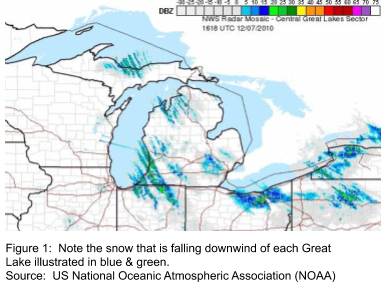
Cities act as heat sinks and can intensify lake effect snow downwind. The blacktop, buildings, and composition of a city warms the air that surrounds a city. Remember, warm air hold more moisture. In addition, pollution from cars and factories ad particles to the air. These particles provide a “seed” or place for ice crystals to form. These ice crystals lead to heavier snowfall downwind from each of the Great Lakes. (See Figure 1)
In summary, the Great Lakes alter the climate and weather in the surrounding regions. Daily and seasonal temperatures vary from other places in the world because waters temperature buffering effects. Lastly, as can be seen, some unique weather phenomena take place surrounding the Great Lakes such as lake effect snow.
Topic: The Great Lakes have a significant influence on regional climate by absorbing, storing and moving heat and water. Lake effect precipitation can occur downwind when major weather systems move over the lakes.