
Connect
Whole Body Grounding Breath
- Begin by standing with your feet firmly planted. Imagine roots holding your feet to the earth and bringing sap/energy up to the top of your head. Stand tall and strong.
- Relax your shoulders by gently dropping your shoulder blades down your back. Bring your chin parallel to the ground. Settle your eyes on a single point. Soften your gaze.
- As you inhale, raise your arms up to the sky. As you exhale, bring them back down to your sides. Imagine all your scattered thoughts and worries floating around you in the air.
- As you bring your hands down, imagine those worries settling down like sunbeams, raindrops, falling leaves or snowflakes (change it up seasonally).
- Repeat.
Once you have taken several deep breathes, add some more movement...as you inhale, raise your arms up AND raise up on your tiptoes, as you exhale, lower your arms AND slowly drop down to your heals. Then, as you inhale, raise your arms, go up on your tiptoes AND lift your gaze upwards so that you are looking up when you rise up and looking down as you lower your body.
Explore
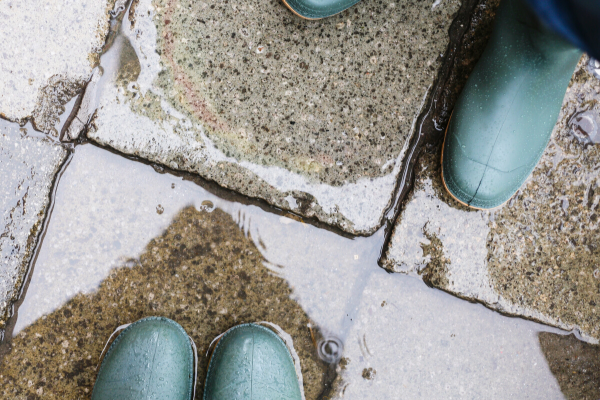
Grab your Nature Notebook and head out the door. Take a walk around your home and yard. What evidence of water do you see? Where do you observe water interacting with things around your home or yard? In what ways do land and water interact? How have humans influenced the way water is moving? What impact might these changes have on your immediate environment or surroundings?
Examples of water you may find include: breath, clouds, puddles, snow, ice, condensation, etc. Look at your rain gutters, ditches, rain barrels, slope of lawn or patio, etc.
If appropriate, play with water outside. You’ll need access to a space where you can be creative and make a mess. Splash, make mud, pour water from above, experiment with floating objects, build with mud or wet sand, fill holes with water, etc.
Create a maze with natural items (twigs, mud, rocks, etc) and see how the water travels through the maze. Create your maze on the ground or use a wash tub, dishes, etc. as your surface. Set it up on the lawn, patio, balcony, etc.
Can you identify the different places water goes in nature and your neighborhood? What causes the water to move? What can you do with your maze to change how the water moves?
Record your water observations in your Nature Notebook along with the date, time, temperature, and weather. Now that you've become aware of water all around, notice as the forms of water change with the weather and seasons.
Reflect
Describe to someone around you what is happening to the water.
Make a phone call to someone and tell them what you learned.
Guide a younger learner in a similar water exploration.
Write a story about water. Include a description of what conditions were necessary for water to move.
Want to share your activity with a picture, drawing, story, or poem on the EEK! website? Email us!
Engage
Learn more about water:
Check out Round and Round it Goes.
Read Recycled, a poem about water.
Learn about The Water Cycle with Project Wet (leaves EEK!).
Find ways to conserve water.
Explore water and the Great Lakes.
Watch this water cycle video:
Consider sharing what you've learned with a friend or loved one or leave a comment below with your reflections!