
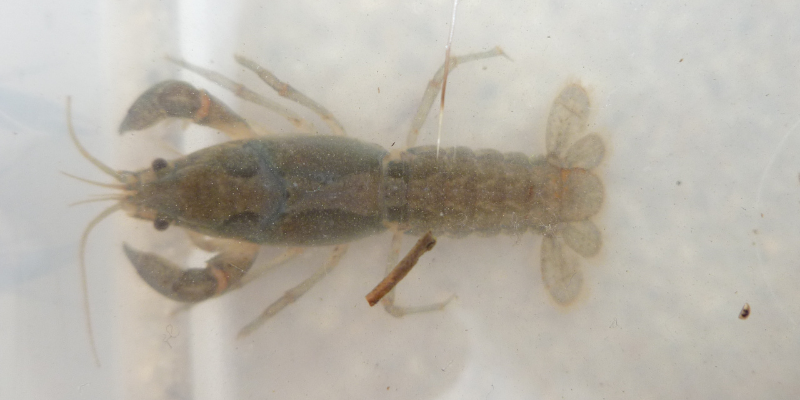
Common names: crayfish, crawfish, crawdads, mudbugs
Scientific name: There are several species of crayfish in Wisconsin. They belong in four different genera: Cambarus, Orconectes, Procambarus, and Fallicambarus.
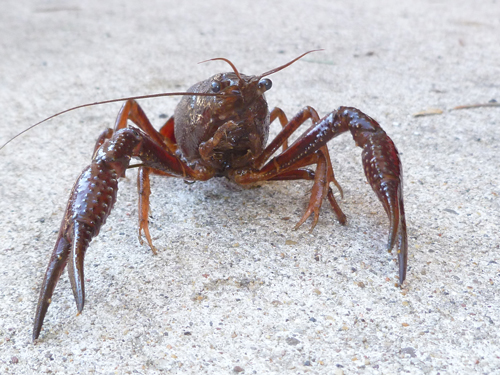

If you are near a wet place and are looking at an animal that resembles a miniature lobster, you are looking at a crayfish! Be careful. Crayfish know exactly how to use those impressive pincers
Crayfish are in the Phylum Arthropoda along with insects and spiders. Like their cousins, they have hard exoskeletons that they must shed in order to grow. When crayfish are shedding their old exoskeletons (molting) and growing their new ones, their bodies are soft, and they can't move very fast. This makes them easy for predators to catch. Queensnakes feed almost exclusively on crayfish that have just molted.
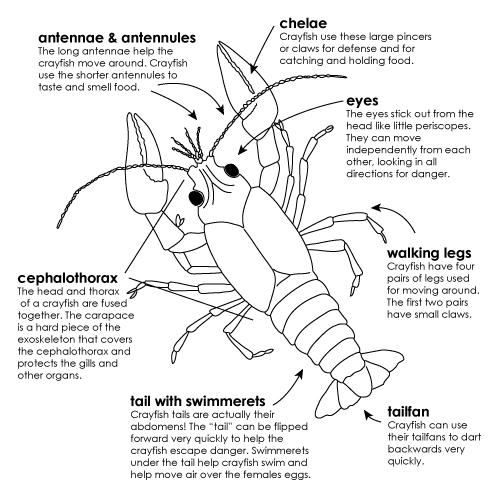
Since crayfish breathe through gills, they must live in wet places like streams, lakes, ditches, wetlands, and wet fields. However, that doesn't mean that they have to be under the water all the time. If their gills are moist and the air is humid, crayfish can get some oxygen directly from the air. This is why you sometimes find crayfish wandering around after a rain.
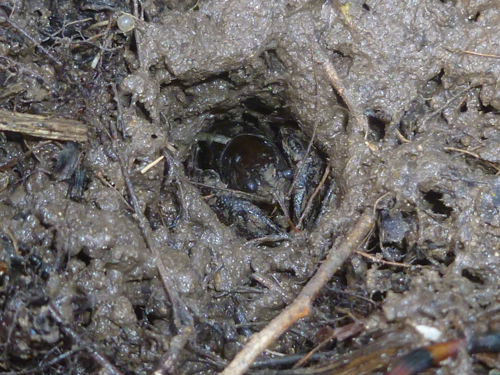
All crayfish burrow in the soil. The crayfish that live in rivers and creeks only create burrows when the water is low. They dig until they find water. Other crayfish spend their whole life underground in the burrows that they construct. These crayfish don't need to live in a permanent stream or river, they just burrow down until they find water. You can find burrowing crayfish by looking for their "chimneys" made of mud.

Crayfish are omnivores and scavengers. This means they eat most anything, including living plants, dead plants, living animals, and dead animals. When food is scarce, they can even be cannibalistic, eating other crayfishes. They are nocturnal and do most of their hunting at night.
A lot of animals eat crayfish, including people! Raccoons, opossums, fish, snakes, herons, mink, and other medium-sized predators capture and eat crayfish. Look for bits and pieces of their exoskeletons on rocks and the edges of wet places.
There are male and female crayfish. The males court the females by waving their antennae and chelipods. They grasp the female and turn her upside down. Then they use special structures called gonopods to place their sperrn inside the females' bodies.
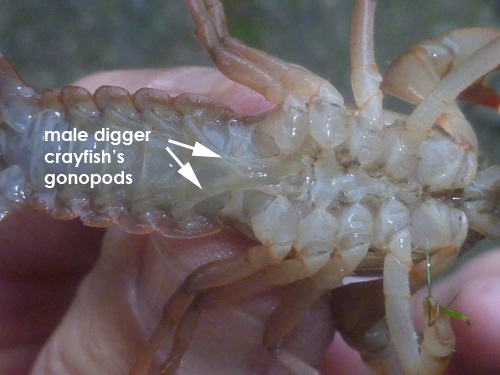
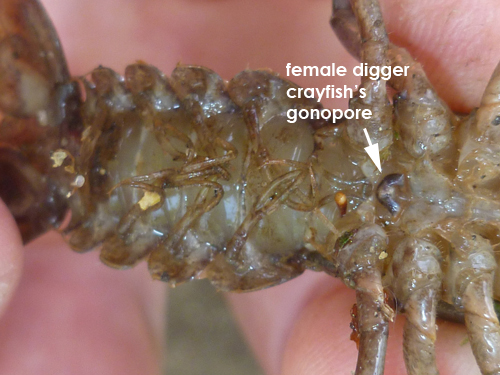
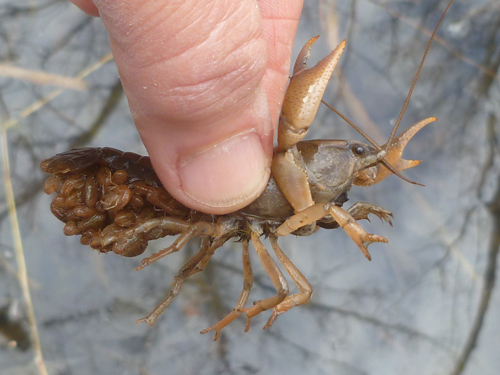
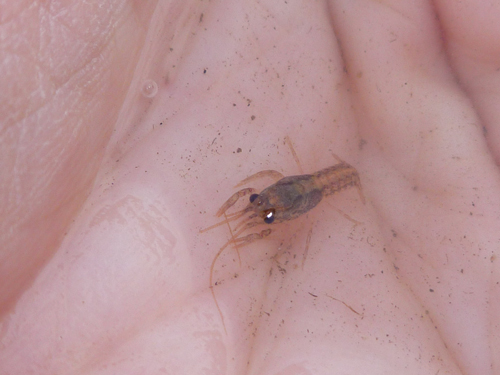
The females store the sperm until they lay their eggs. The eggs are released from the gonopore. The mother crayfish attaches the fertilized eggs to the underside of her abdomen. When they hatch, the young remain attached to the mother until they have molted several times. The mother crayfish will curl up her abdomen to protect them. In the spring and fall, look for eggs or young attached under the female's bodies.
The study of crayfish is called astacology.
If a crayfish loses one of its pincers or even one of its legs, it can regenerate it. It will probably never be as big or as strong as the original, but something is better than nothing!
Not all crayfish that you find in Wisconsin are native to Wisconsin. If your crayfish has rusty spots on its shell, it is an alien invader. Find out more about rusty crayfish.
This video from The Parklands in Louisiana will help you learn about crayfish.