
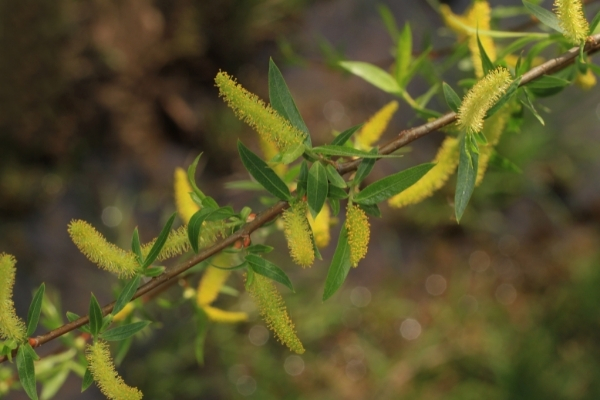
Black willows are part of a large family of trees and shrubs that usually grow along streams and in other moist places. The black willow is native to Wisconsin. Weeping and crack willows are exotics brought into Wisconsin from somewhere else.
Different kinds of willows grow as trees and as shrubs, reaching from several feet high to full tree size. The black willow grows an average of 30-40 feet high, but sometime it is a large tree with leaning trunks and sometimes it is a tall shrub with a short trunk and spreading branches.
Here's how to identify willows by their leaves and twigs:
Leaves are long, narrow, greenish-yellow with whitish undersides that grow on long, slender, somewhat twisted stems with branches that droop.
Leaves are large with a saw-toothed shape. Twigs break easily from the branches.
Leaves are narrow with widely spaced teeth, rounded, dark green atop with a whitish bloom below.
Leaves are smaller and finely toothed with a silky feel.
Leaves are very narrow and green on both sides.
Leaves are whitened or pale beneath, long branches hang down towards the ground.
Willow Bark: The bark is thick, rough, and flaky with dark brown to grey coloration on large trees.
Fruit: Flowers grow in dense, long clusters known as "catkins." They bloom in the spring when leaves come out. Seeds are tiny, and mature in late spring or early summer. I bet you know what pussy willow catkins look like. You find them early in the spring looking like soft, furry buds.
Range: Varieties occur throughout Wisconsin and the U.S. from wet areas to dry prairies.
Wood Use: Wood from willows is light brown, soft, weak, flexible, coarse-grained. It has thin whitish sapwood. Wood is used for fuel, erosion control, basketmaking, landscape plantings, windbreaks, and charcoal.