
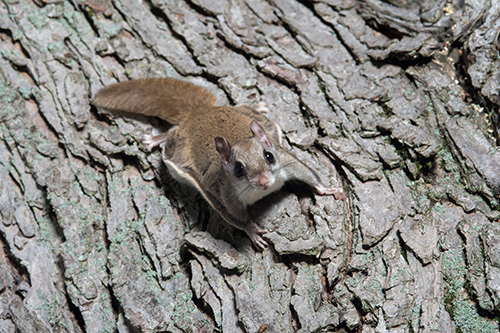
Common name: northern flying squirrel
Scientific name: Glaucomys sabrinus
Look out Bullwinkle! Here comes Rocky
It's small and furry. It "flies" from tree to tree. It's Wisconsin's own version of Rocky, the flying squirrel! There are two kinds (species) of flying squirrels in Wisconsin--the northern flying squirrel and the southern flying squirrel. This article is about the northern flying squirrel. It is a species of Special Concern in Wisconsin.
How to identify flying squirrels
Northern flying squirrels are in the rodent family. Tree squirrels, like gray squirrels and red squirrels, are active during the day. Flying squirrels are nocturnal and active at night. They have large eyes that allow them to see better at night. The fur on their backs is usually brown or cinnamon colored. The sides of their face, under the ears, and the neck are a pale gray. The fur on their bellies is gray or pinkish close to their body, but it has a white tip. They are small, weighing about 5 ounces. For comparison, a large chicken egg weighs 5 ounces! They are about 12" long, but almost half of that length is their broad, flat tails.
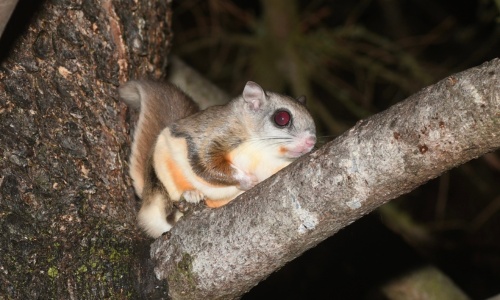
The most amazing thing about flying squirrels is their patagium! This is an extension of the skin that covers their body. The skin attaches from their front legs to their back legs. When flying squirrels stretch out their legs, this skin also stretches out and becomes like a built-in glider.
The flying squirrel doesn't really fly. It gets around by "volplaning." It climbs high in a tree, then leaps with legs extended and its patagium (the fold of skin that extends from wrist to ankle) outstretched, gliding in a descending curve towards another tree. At the end of its glide, it swings upward and lands head up on a neighboring tree. It repeats this move over and over as it moves about. It can glide anywhere from a few feet to 150 feet! Not bad for a little squirrel! The northern flying squirrel also hops around on the ground.
Where they live
Northern flying squirrels live in the northern part of Wisconsin in heavily wooded areas with both conifer and deciduous trees. In the summer, they build nests (or dreys) made of leaves and twigs. In the winter, they find holes in trees (tree cavities) for protection from the wind and cold. Sometimes they move into an abandoned woodpecker nest; sometimes they find a natural cavity in a tree. Their nests may be up to 60 feet above the ground. Flying squirrels that are related to each other huddle together in winter for warmth and protection. If left undisturbed, flying squirrels stay in their nests during the day.
What they eat
These small squirrels eat:
- Nuts (hazelnuts, acorns, beechnuts)
- Seeds (spruce, balsam, and maple)
- Fruits (pin cherry, juneberry, huckleberry, mountain ash)
- Mushrooms and other fungi
- Tree buds (especially late in the winter and early spring when food is scarce)
- Raw meat (young birds, bird eggs)
Who eats them
Flying squirrels need to be on the watch for house cats, foxes, weasels, martens, great horned owls, and goshawks. These predators will make a meal out of this little squirrel.
Did you know?
Since flying squirrels are nocturnal, you're not likely to see one. Although, they have been known to check out a campfire or cabin light in search of food. You might also hear one rummaging in the trees or on the ground for food.
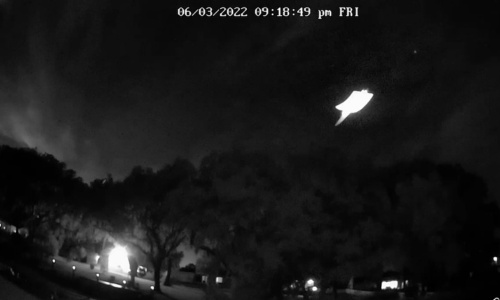
The image above was captured by a trail camera. The camera's flash caught the white belly of a flying squirrel gliding through the air. If you're camping, and you think you see something gliding from tree to tree, keep watch. You may get a visit from a northern flying squirrel.
Check out this video! A college professor in Wisconsin discovered an amazing thing about flying squirrels.