
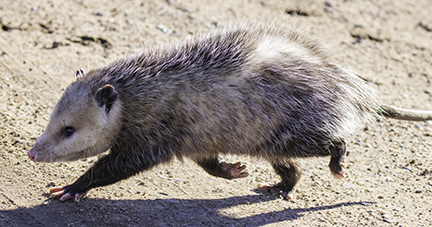
Common name: opossum, Virginia opossum, ‘possum, North American opossum
Scientific name: Didelphis virginiana
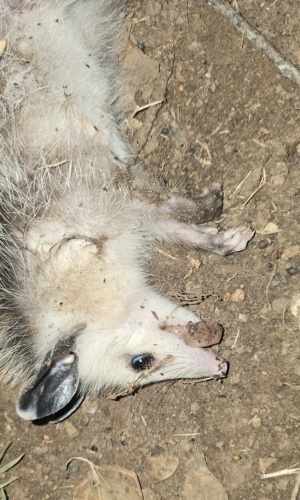
Have you ever heard of playing 'possum? Opossums are equipped with many sharp teeth, but their best defense is all an act! When threatened, an opossum will freeze in place. If that doesn’t work, it will snarl, growl, and hiss. If that doesn’t work, it 'plays dead.' The opossum becomes limp and falls on its side. Drool comes out of its gaping mouth. Green, smelly mucus comes out of its anus. You can gently poke the opossum with a stick, and it will remain motionless. Most would-be predators think twice about eating a dead, smelly meal.
Opossums don’t really think about playing dead as a way to avoid being eaten. Their bodies just shut down automatically.
How to identify an opossum
Opossums are about the size of a large house cat. Their fur is light gray to almost black with white tips. They sometimes look silvery. Their face and neck are white. They have a long scaly tail, a cone-shaped muzzle with long whiskers and a pink nose, round hairless ears, short legs, and naked feet. Opossums are 24 to 33 inches long and weigh six to 15 pounds. Males are larger than females.
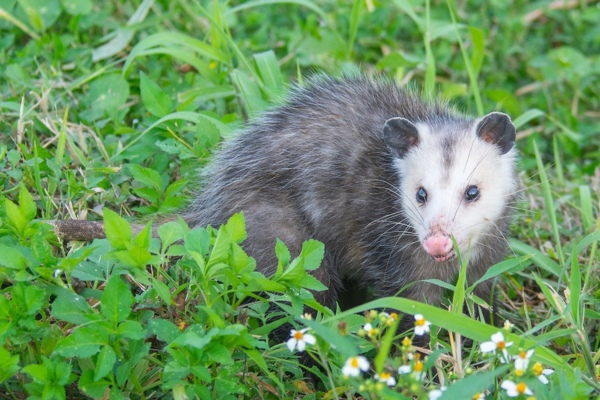
Opossums use the “thumb” on their back feet to grab onto tree branches when climbing. When they are young, they can hang by their prehensile tail. Prehensile means that it can be used for grasping. When opossums get older, they are too heavy to hang by their tails, but they still use their tails to help keep their balance while climbing.
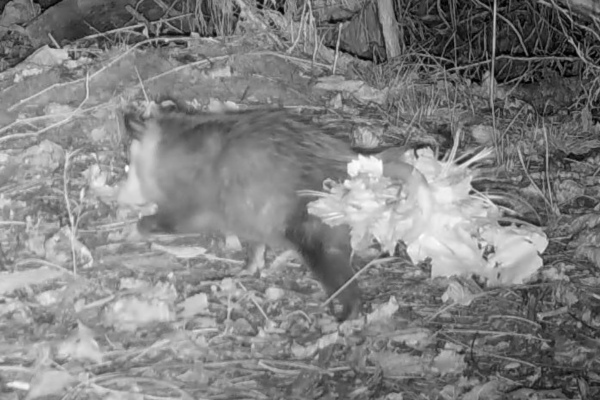
How to recognize opossum tracks
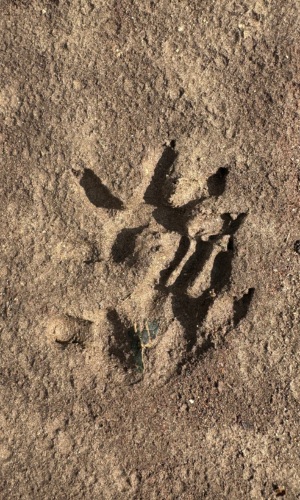
Opossum’s feet are very different from other mammals. They have five toes on their front feet that leave star-shaped footprints. They have a large thumb on their back feet that leaves a very odd track. Sometimes they drag their tails, but they usually don’t leave tail marks when walking.
Opossums waddle when they walk, moving one side of their body followed by the other side of their body. They leave behind pairs of footprints with a front paw near a back paw.
Where they live
Opossums live in woodland areas, grasslands, and fields. They usually live near water. They have also adapted well to living in suburbs and cities. They nest and find shelter in standing dead trees, hollow logs, brush piles, abandoned burrows, rock culverts, and under buildings. During the daytime, opossums hide in hollow logs, trees, brush piles, road culverts, rock and stump crevices, and under buildings. Their habitat range is from 20-40 acres.
Opossums didn’t live in Wisconsin before the 1850s. As European settlers cut down forests and planted crops, opossums began moving north into Wisconsin from the south. With their hairless body parts, opossums are not really adapted to living in extremely cold places. You might see an opossum with parts of its ears, tails, toes, or nose missing. Frostbite probably damaged these naked body parts.
What they eat
Opossums are omnivores, and they will eat almost anything. They eat a variety of plants, including seeds, berries, fruits, nuts, crops, and vegetables. They also eat a variety of animals, including invertebrates, birds, eggs, small mammals, amphibians, and fish. Around people, they find food in garbage cans, compost bins, and gardens. They also eat dead animals or carrion. When they feed on roadkills, they can become roadkills themselves.
Opossums fatten up on food before winter arrives, but do not spend all winter in the den. They will come out to look for food during warmer spells.
Who eats them
Foxes, coyotes, wolves, bobcats, owls, hawks, and feral dogs and cats will capture and eat opossums. People also hunt and trap opossums for their meat and fur. Indigenous people, especially those living in southern areas, eat opossum. They taught European settlers how to cook and eat opossum.
How they reproduce
Opossums are marsupials which means they have a pouch on their abdomen where their young are carried and nursed on milk.
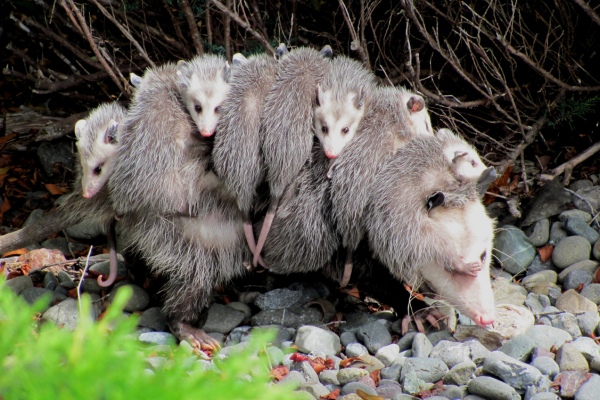
In Wisconsin, opossums mate in March. After only two weeks, opossum mothers give birth to three to 25 young. The babies are about the size of a bean. They are not fully developed, but they do have tiny claws on their front feet. They use the claws to climb three to four inches upward and into the pouch where they compete to attach to a nipple. There are only thirteen nibbles. If a baby does not find a nipple in time, it will die. They stay attached to the nipple in the pouch for 60 to 70 days. When they are the size of a mouse, they can hang onto the mother's back while she searches for food. They remain with their mother for three or four months.
Did you know?
Opossums are the only marsupial in North America. They share a common ancestor with the marsupials that live in South America, Australia, and islands around Australia. That means they are related to kangaroos, Tasmanian devils, koalas, sugar gliders, honey possums, shrew opossums, and other strange animals!