
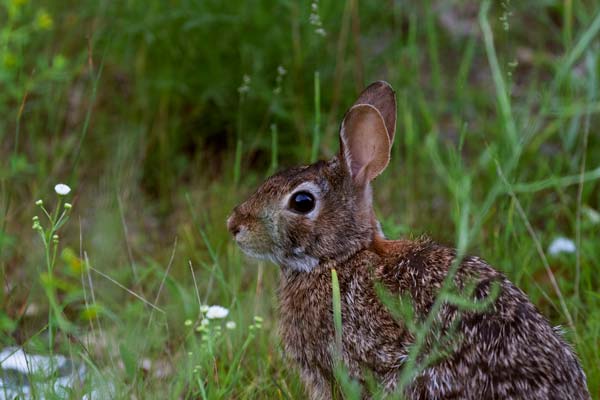
Common name: eastern cottontail, cottontail rabbit
Scientific name: Sylvilagus floridanus
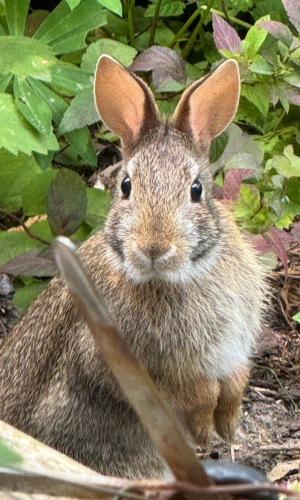
Cottontail rabbits live all over Wisconsin. They are abundant in the southern two-thirds of the state and common in northern towns and cities. Rabbits are fun to watch and photograph because they will let you get pretty close before running away. Hunting rabbits is also popular in Wisconsin, and people value these animals for their meat and fur.
How to identify a cottontail
Cottontails are named for their short, fluffy, white tails that look like big cotton balls. The fur near the neck, legs, and tail is cinnamon colored. The fur on the belly is bright white. Most cottontails have a little white spot on the forehead.
Adult cottontails are 14 to 18 inches long and weigh up to 4 pounds. Females are larger than males. Look for long ears that can pivot around like a satellite dish to catch sounds from all directions. They have excellent vision.
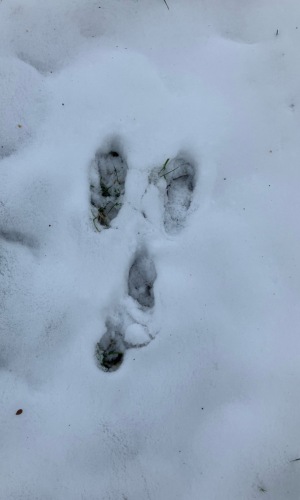
How to recognize rabbit tracks
Rabbits usually move slowly, hopping short distances. But when they are escaping from predators, rabbits can travel up to 18 miles per hour for short distances.
Rabbits hop by pushing off with their strong back legs, curling their bodies, reaching out with their front paws, and pushing off with their back feet again. When they are hopping, their back feet land in front of the tracks left by their front feet. The front feet do not usually land side by side; the back feet do.
Rabbits are fun to track through the snow. Gray squirrels leave very similar tracks except for two big differences: squirrel tracks often disappear at the base of a tree, and a squirrel’s front feet land side by side.

Where they live
Rabbits live in a variety of habitats, including sparsely wooded areas, thick brushy places, farmlands, orchards, and even your neighborhood. They memorize escape routes and hiding places like rock piles, brush piles, hollow logs, and shrubs. Cottontails travel a range of eight acres and can be seen year-round at any time of day or night, but they are most active during dawn and dusk.
What they eat
Cottontail teeth are adapted for ripping and gnawing on plants. Their sharp incisors (top front teeth) constantly grow, allowing them to gnaw away on tough plants for a lifetime. In summer they eat alfalfa, clover, peas, beans, grass, dandelions, and other garden plants! In winter, they munch on the tender parts of trees and shrubs, such as the buds, sprouts, and shoots of apple, blackberry, birch, maple, willow, basswood, and sumac. In places that receive a lot of snow, you might find twigs eaten by rabbits three or more feet above the ground. How could a small rabbit possibly reach twigs and buds so far off the ground?
Who eats them
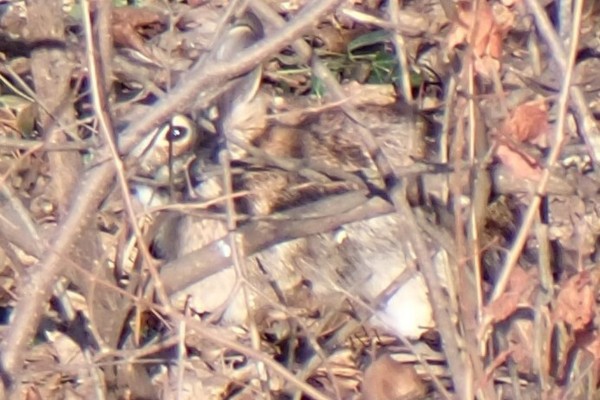
If you like to play freeze tag, you might want to take a few lessons from the cottontail rabbit. They are experts at "freezing" in place. But they're not playing a game of tag, they're trying to stay alive. When another animal approaches, the cottontail will "freeze." By sitting perfectly still, it tries to avoid being noticed. If freezing doesn't work, and the threatening animal continues toward it, the rabbit will take off, hopping in a zig-zag pattern. If you have rabbits in your yard, you've probably seen this happen.
There are a lot of animals that would eat a rabbit! Newborn and young rabbits are especially vulnerable to predators. Here are a few:
- Foxes, coyotes, and wolves
- Bobcats and lynx
- Badgers, raccoons, weasels
- Owls and hawks
- Dogs and cats
- Snakes
- Vehicles on the roads
Only a few rabbits survive until their first birthday. The average lifespan is about 15 months. An old wild rabbit is only five years old.
How they reproduce
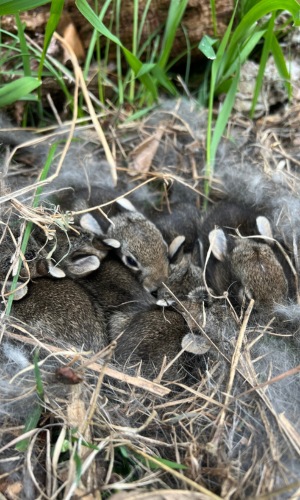
Male and female rabbits perform a kind of dance or ritual before mating. After mating, females make a "nest" by scraping a shallow depression in the ground and lining it with grass and fur. After 28 to 32 days, three to six young are born naked, blind, and almost helpless. Young weigh about 1 ounce and measure 4 inches long at birth. They grow rapidly on their mother’s milk. By five weeks, they are weaned and independent. Rabbits are considered mature at four months! Females may have up to three litters each year between February and August. They can mate almost immediately after giving birth.
Did you know?
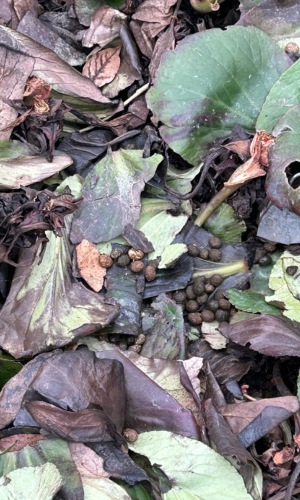
Rabbits eat their food twice! Think about that. If you are imagining that they eat their poop, you are close.
Plant material, especially things like buds and twigs, is hard to digest. After a rabbit partially digests the plant fibers in its intestine, it “poops” out cecotropes. These are very soft droppings that the rabbit eats as they come out of its anus. This allows the rabbit to digest the food a second time and to absorb more of the nutrients.
This process is a little different from coprophagia. Coprophagous animals actually eat their own poop. Hamsters, koalas, and pigs are examples of coprophagous animals. Dung beetles might occasionally eat their own poop, but they specialize in eating the feces of other animals.