
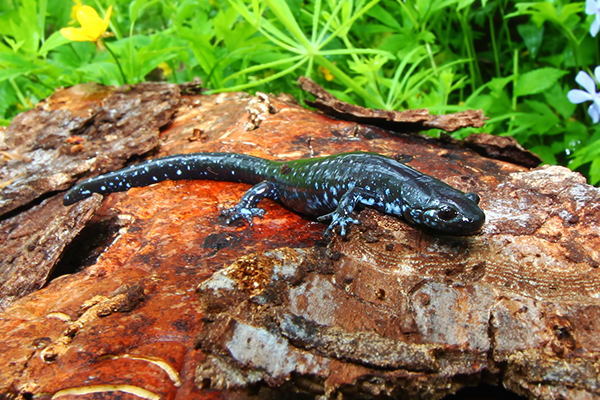
Common name: blue-spotted salamander, blue spots
Scientific name: Ambystoma laterale
Blue-spotted salamanders are one of three species of mole salamanders in Wisconsin. The mole salamanders (blue-spotted, spotted, and tiger salamanders) spend most of their time underground.
How to identify
The blue-spotted salamander is 3 to 5 inches long. It is slender with dark blue-black coloring. Look for light blue specks all over its body, but especially along its sides. It has four toes on its front feet and five on its back feet. If you happen to find a salamander that has just transformed, it will have light yellow spots.
Where they live
Blue-spotted salamanders live all over Wisconsin except the far southwest corner of the state. They live in both hardwood and coniferous forests. They can survive in drier places than most Wisconsin salamanders. You can find them living in forests with sandy soils as long as there are woodland pools that can hold water into late summer.
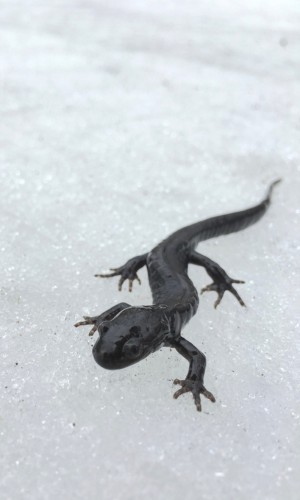
During the winter, salamanders burrow into leaf litter or crawl down into holes. There they wait for warmer days. But sometimes they don't wait! Check out this blue-spotted salamander on top of snow! As cold-blooded animals, their body temperatures rise and fall with the outdoor temperatures. If the outdoor temperature is below freezing, the body of the salamander should be too cold to move about. But these salamander are equipped with some type of natural antifreeze that allows them to be "supercooled." Not only are they alive at frigid temperatures; they can move around.
What they eat
Blue-spotted salamanders are nocturnal, coming above ground at night and on dark, rainy days to look for food. They are carnivores, eating invertebrates like earthworms, snails, slugs, spiders, and insects. The larvae are also carnivores. They eat aquatic invertebrates.
How they reproduce
Salamanders return to ponds to mate in the water. The male holds on to the female and rubs her head with his chin. He deposits a packet of sperm, called a spermatophore, on the bottom of the pond. The female picks up the spermatophore with her cloaca. A cloaca is a single opening for the digestive, urinary, and reproductive systems.) The eggs are fertilized internally.
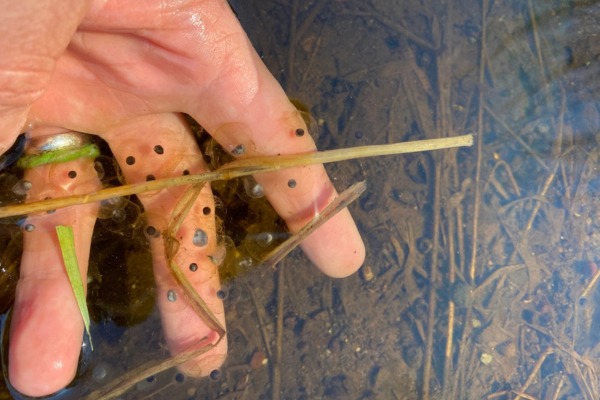
The female usually lays her eggs in clusters and attaches them to twigs or other vegetation under water. They look like a glob of gel. When the eggs hatch and the larvae start to develop, they look like a glob of gel with eyeballs!
The larvae hatch in about one month. Over the next few weeks, the larvae develop front legs and back legs. They stay in the water until they completely transform into adult salamanders.

Did you know?
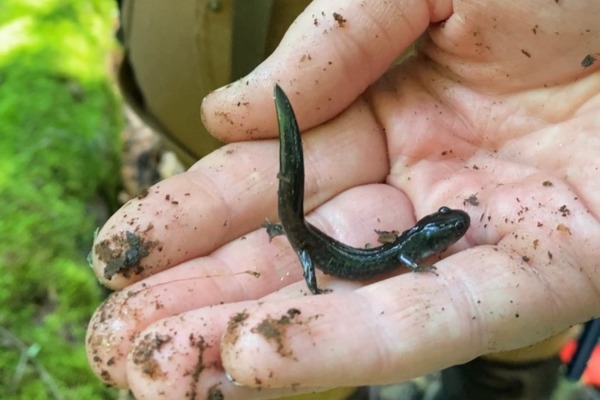
Blue spots might be little, but they are not defenseless. Their coloration helps them hide from predators. If a predator gets too close, the salamander raises its tail over its back. It can wiggle and curl its tail around. At the same time, it releases a bad-smelling, sticky substance from a gland near the base of its tail. If a predator attacks, it is most likely going to bite that wiggling tail. Since salamanders taste bad, the predator might spit the salamander out. Even if the tail should get bitten off, the salamander can regenerate it!